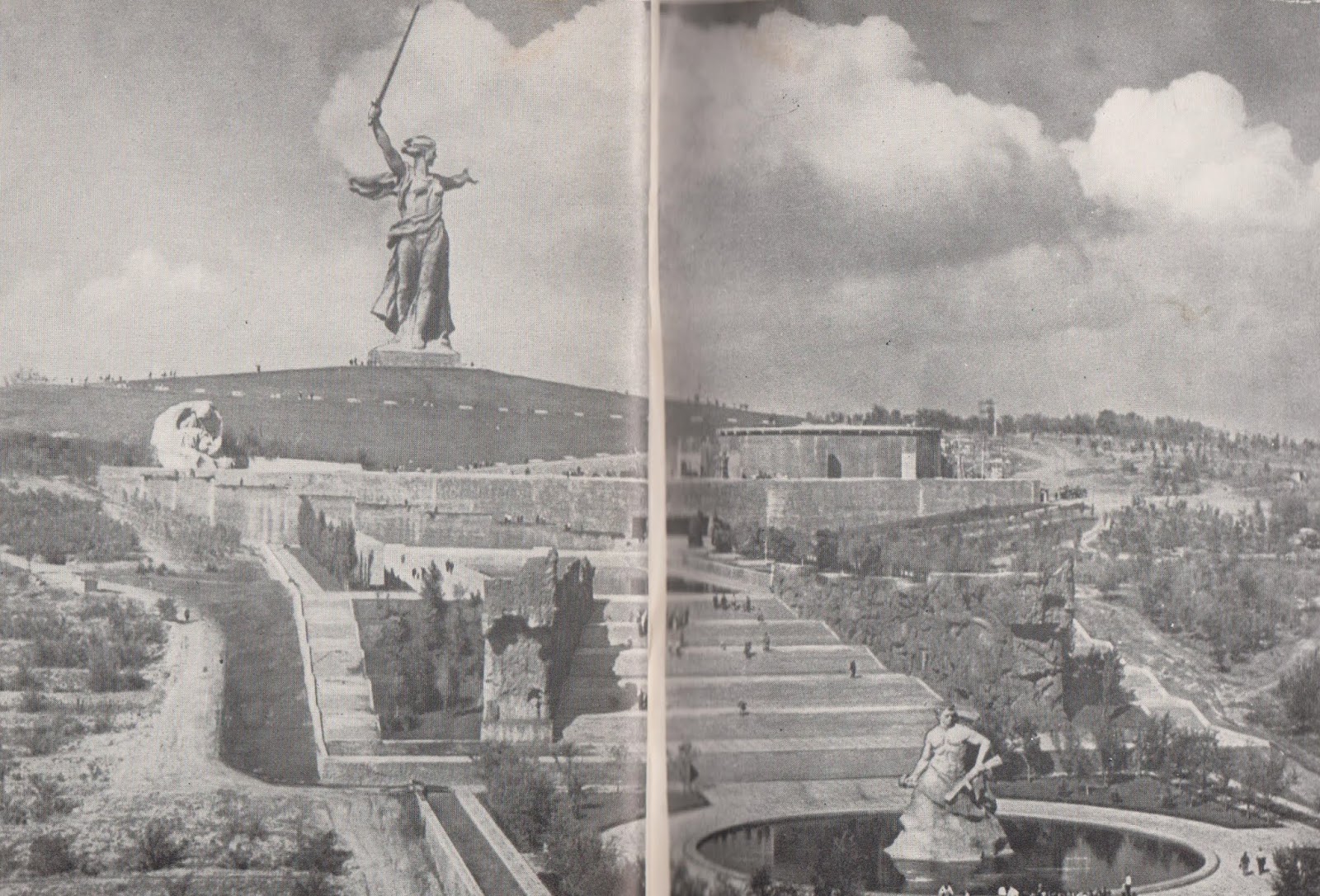
On January 26, 1943 Soviet forces captured the heights of Mamayev Kurgan in the city of Stalingrad from the Nazis ending 135 days of brutal fighting there. Several days later, on February 2, the Nazis capitulated and one of the most pivotal battles in the war and in the history of the modern world was over. The Battle of Stalingrad, along with the later Battle of Kursk, was the turning point that led to the defeat of the Nazis in the ruins of Berlin.
Mamayev Kurgan, as a key strategic point, was exceptionally important to the defense of the city and many of thousands of Red Army soldiers sacrificed their lives there fighting the fascist invaders.
After the war it was made into a huge memorial complex to the fallen which was finished in 1967. This complex includes the famous and magnificent statue The Motherland Calls.
In 1968 a Soviet booklet related to the memorial complex was published. I have translated some of the text about the history of the battle and have included all of the photos in it.
Text:
Humanity will forever remember the feat of the defenders of Stalingrad. Here the Soviet soldiers and laborers of the hero-city stopped the frenzied onslaught of Hitler's selected divisions. The ensuing encirclement and liquidation of a huge army of invaders meant a radical change in the course of the entire Second World War.

By the middle of September 1942, the situation in the streets of Stalingrad was very difficult for the Soviet troops. On September 12 captured several heights dominating the city, took key positions on the outskirts of the Stalingrad Tractor Plant, and concentrated a powerful group of tanks and infantry to strike. The German invaders had only 3-4 kilometers to reach the center of Stalingrad. Having seized advantageous positions for an attack on the city, on September 13 the German troops began the assault on Stalingrad. On -_- the uplift of the 6th German Army unfolded from the region of the aviation city of the village of Gumrak in the direction of Mamayev Kurgan and the station. The main blow fell on the troops of the 62nd Army. The Germans succeeded in a few areas to slightly penetrate the defenses of ours. On the afternoon of September 14, German troops, advancing through Mamaev Kurgan to the city center, seized Stalingrad 1st Station. Now the 62nd Army was not only cut off from the north from the troops of the Stalingrad Front, but also from the south, from the main forces of the South-Eastern Front. The transfer of troops and ammunition for the 62nd Army from the east bank became more complicated: the moorings and the entire space of the river the enemy kept under artillery fire, mortars and heavy machine guns. From dawn until dark, dozens of fascist bombers swooped onto the central pier. The enemy sought to block the 62nd Army, to prevent the supply of ammunition and food from the left bank, to prevent the transfer of fresh reserves to the right of the Volga bank.
But these attempts were thwarted by the active actions of our troops, who had thrown back the German machine gunners who had broken through to the central station. Riverboats and vessels of the Volga Flotilla with subunits of the 13th Guards Division, commanded by Major General A.I. Rodimtsev, began to arrive at the pier from the opposite bank. During the night, two regiments of the division crossed over to Stalingrad. They immediately attacked the enemy and knocked him out of the city center. September 15th all the regiments of the 13th Guards Division were already fighting in Stalingrad. September 16 Guardsmen stormed Mamayev Kurgan. To get some idea of the nature of the battles these days, suffice it to say that on September 14 and 15, in the battles for the central part of the city, the enemy alone lost more than 2 thousand people killed. Our troops knocked down and destroyed more than 50 tanks.
On September 15, fierce battles flared up in the area of Stalingrad 1st station. The station changed hands several times. September 21, the Germans again occupied the station. But not for long. On the night of September 22, our units struck them hard. The enemy suffered heavy losses in tanks and manpower. By active actions, Soviet troops forced the fascist invaders to keep reinforced garrisons in the occupied quarters and houses. From mid-September, the streets and squares of the city became the scene of fierce battles, which then subsided, then flared up with a new force. Despite major losses, the enemy stormed the city from morning to evening. By September 27, he occupied a fairly wide area from the Tsaritsa River to Kuporosnoe, and had captured half of the Mamayev Kurgan. In the center of the city, the fascist German troops marched toward the Volga. The defenders of Stalingrad were pressed to the very shore of the river.
During this difficult period of the Battle of Stalingrad, the soldiers of the 62nd Army fought with exceptional stamina and selflessness. There were days when they had to repel 12 or more enemy attacks. A fierce struggle was fought for each quarter, for each street, for each house, and in houses - for floors and rooms.
The key position of the defense of the city was Mamayev Kurgan which was fought over from September 28, 1942 until January 26, 1943. The workers of the Stalingrad Tractor Plant provided great assistance to the units in the battles for the city. They repaired tanks at night directly at the front or they were taken away to the factory and a few hours later returned to the crews.
It should be borne in mind that only the 37th Guards Division and the 84th Tank Brigade had 75 percent of the personnel, while the rest of the divisions were extremely exhausted and fought in small assault groups. But even under these conditions our warriors not only defended themselves, but also went over to counterattacks. Hitler's troops continued to storm the positions of the defenders of Stalingrad, consistently directing their attacks in the northern region, with the goal of seizing the Barricades and Red October factories and defeating the main forces of the 62nd Army. Persistent and intense battles for these plants continued until the end. On October 23 and 24, separate groups of the enemy managed to break through to the territory of the factories, but they could not fully master them. The battles were for factory buildings, for individual shops, and in the shops themselves.
The persistence of our fighters won, with which all the commanders shared the sorrows and joys, from platoon commander to army commander. Our tactics gained the upper hand over the enemy's. An important role in the battle for Stalingrad was played by the Soviet artillery. The high art of the combat use of artillery by the command of the front and the armies and the skill of the artillerymen to a considerable degree ensured the resilience of the defenses of Soviet troops. The distinctive features of the combat use of artillery in defensive battles were its massive use and the centralized control of artillery fire.

During the days of defensive battles in the factory district and for Mamayev Kurgan, the sniper movement became widespread, initiated by the hero V. G. Zaitsev. Both the Front Military Council and the Provisional Councils of the 62nd and 64th armies attached special importance to this movement. Talented shooters, whether in a position alone or in pairs, carefully studied the behavior of the enemy and hit the most important of them with precise shots. Soviet snipers brought a lot of trouble to Nazi commanders.
The workers of the tractor factory and Barricades factory fought side by side with the soldiers of the 62nd Army. Along with the troops of the 62nd Army, which during the entire defensive battle endured the main attacks of the enemy, the formations of the 64th Army made a great contribution to the defense of Stalingrad. The former commander of the South-Eastern Front, A. I. Yeremenko, in his book “Stalingrad”, commends the combat activities of the troops of the 64th Army and its commander, Major-General M. S. Shumilova. “The 64th Army under his command,” writes the Marshal of the Soviet Union “played an exceptional role in the battle of Stalingrad. Her perseverance and activity in defense, her agility and mobility on the battlefield caused the enemy a lot of trouble, caused him great damage, disrupted many of the enemy’s calculations, helped to thwart more than one of Hitler’s designs for the seizure of the city."
The army managed to keep its heights located to the south of Stalingrad, which played a significant role in the sustainability of the defense of the city as a whole. By the end of the defensive period, the troops of the 62nd Army firmly held the area north of the tractor plant, the Lower Village of the Barricades plant and the northeastern quarters of the central part of the city, and the troops of the 64th Army the approaches to the southern part. The Stalingradists honorably kept the oath they had given - they repelled the frenzied onslaught of the fascist hordes rushing to the Volga, exterminated the best German divisions, defended the Stalingrad hell.
It was a great feat of the Soviet people, an epic of courage and the selfless steadfastness of hundreds of thousands of soldiers, commanders, and workers.
To commemorate the victory of the Soviet people and their army in the Stalingrad battle, which ended February 2, 1943 with the defeat of the enemy, by the decision of the Soviet government a huge memorial complex was erected. The ensemble of sculptural compositions and architectural structures of the monument is located on the site of the longest battle of the forces of the opposing sides - on the Mamayev Kurgan. The fierce fighting lasted 135 days on this section of the frontage, the height above the city.
In the days of the Battle of Stalingrad, Mamayev Kurgan became the key position of the city’s defense. Who held the top of the mound in his hands, ruled over the district. That is why there was a fierce battle here for so many days and nights. How many mines and high explosive bombs rained down here -- it is impossible to count. Only one thing is known: the steep slopes of the mound were relentlessly pounded by explosions of shells and bombs.
In the days of the battles, even in winter, the mound turned black as if charred. It seemed that it would remain so. But the life-affirming power of our Soviet society, the creative work of people working at this legendary height in peacetime, won another victory. And we have the right to be proud of this victory as well.
Mamayev Kurgan became a symbol of life, the immortal glory of the warriors and laborers who died here. Parks, squares, gardens, a green carpet of grass decorates the slopes of the mound. Mamayev Kurgan is now crowned with a majestic sculptural ensemble. Almost all the compositions of the sculptural ensemble seemed to have grown out of the ground and to be frozen forever before the mass graves of the heroes of the great battle. From now on, the legendary height serves as a monument to the Great Stalingrad Battle.
Introductory Composition:
Alley of the Poplars:
The Soldier Rises:
Wall of Ruins:
Hero Square:
Hall of Military Glory:
Grieving Area:
The Motherland Calls: