Showing posts with label Cheri DiNovo. Show all posts

Sunday, September 24, 2017

Anthem Protests, Vietnam Revisionism, Korea and more -- The Left Chapter Sunday Reading List September 17 - 24


This week's list of articles, news items and opinion pieces that I see as must reads if you are looking for a roundup that should be of interest to The Left Chapter readers.


This list covers the week of  September 17 - 24. It is generally in order of the date of the article's release.

1) Food bank usage in Toronto back to recession-era levels, report says

Fatima Syed, The Toronto Star

Suzanne Davison, a 72-year-old who lives in federal co-op housing in Toronto with her 63-year-old brother, goes to her local food bank every week.

Read the full article

2) Voters overwhelmingly support Jeremy Corbyn's policy agenda, poll finds

Joe Watts, The Independent

The British public has given overwhelming backing to major parts of Jeremy Corbyn’s policy agenda, new polling has revealed.

Read the full article.

3) Kinew needs to come clean, NDP needs to speak up

Melissa Martin, Winnipeg Free Press

Seven years ago, on a breezy day in late August, my live-in partner put his hands around my throat and slammed me into our couch. We’d been arguing, again, and this time his anger lashed out like lightning, a sudden electric shock.

Read the full article.

4) Indigenous MLA's attempt at damage control too little, too late

Gordon Sinclair Jr., Winnipeg Free Press

I hadn’t expected the message Tara Hart’s older sister and mother had waiting for me when I called Sunday afternoon to see how they were doing after they had finally shared their feelings about Wab Kinew in that morning’s Free Press.

Read the full article.

5) Documents show B.C. ‘Climate Leadership Plan’ was cooked up in Calgary boardroom of powerful petroleum industry lobby

David Climenhaga, Alberta Politics

Using documents obtained through a Freedom of Information filing, the British Columbia office of the Canadian Centre for Policy Alternatives has discovered B.C.’s former Liberal Government’s “Climate Leadership Plan” was almost entirely cooked up at secret meetings with oil and gas industry representatives in the Calgary boardroom of the country’s most powerful fossil fuel industry lobby group.

Read the full article.

6) “Ossies,” former East Germans, compare socialist youth with life under capitalism

John Wojcik, People's World

A crowd gathered at the Babylon Theater here Saturday for an annual memorial for Dean Reed, the American “rebel,” rock star, and filmmaker who famously defected to “East Germany” (the German Democratic Republic, or GDR) in 1972. Those in attendance were among Reed’s most ardent fans, of whom he had many thousands in the GDR when he died in 1986.

Read the full article.

7) Jews in Texas are already in hiding from neo-Nazis, high holiday service to be held at a secret location

Steve Russell, Newsweek

There's an apocryphal story from WWII that when the Nazis started requiring the Jews under their control to wear gold stars, the Danish King donned one himself and suggested his subjects do the same. It’s an inspiring story, and it ought to be true, but it is mere folklore in the service of the more mundane historical truth: the Danes saved most of their Jewish population from the Holocaust, but by more conventional methods.

Read the full article.

8) Burns and Novick, Masters of False Balancing 

Jerry Lembcke, Public Books

When Karl Marlantes takes the screen during the new PBS film series The Vietnam War, he says coming home was nearly as traumatic as the war itself. Later, he describes being assaulted by protesters at the airport, invoking the image of spat-on Vietnam veterans, an image that Los Angeles Times editorial writer Michael McGough said in 2012 was based on a myth. An edifying myth, McGough called it, but still a myth.

Read the full article.

9) Ken Burns’s Vietnam Documentary Promotes Misleading History

Jeremy Kuzmarov, Vietnam Full Disclosure

Ken Burns and Lynn Novick’s documentary on the Vietnam War began airing on PBS last night after much anticipation.

The film follows previous Burns works in providing poignant footage mixed with compelling interviews and a backdrop of good music, starting in this case with Bob Dylan’s A Hard Rain’s Gonna Fall.

Despite the counter-cultural veneer, however, and admirable efforts to provide a Vietnamese perspective, Burns and Novick’s film in its first episode provides conventional analysis about the war’s outbreak and can be understood as a sophisticated exercise in empire denial.

Read the full article.

10) Getting the Gulf of Tonkin Wrong: Are Ken Burns and Lynn Novick “Telling Stories” About the Central Events Used to Legitimize the US Attack Against Vietnam?

James Williamson, Counterpunch

This past spring I attended an advance screening of excerpts of Ken Burns and Lynn Novick’s documentary about the US War against Vietnam at Harvard, with these two in attendance, along with some Kennedy School “national security” types, who had evidently been recruited as “consultants.” (I was happy to see Peter Davis, the director of the truly commendable “Hearts and Minds” in the audience, to whom I had a chance to say “hello” before I left. Peter is himself a Harvard grad, is now writing novels and, happily, was acknowledged by Ken Burns as he began the post-screening discussion.)

Read the full article.

11) How AIDS campaigners joined the fight to pimp prostitution 

Julie Bindel, Newsweek

The HIV/AIDS movement is widely understood as one that focuses on civil rights and health care for vulnerable groups. The popular perception is that the AIDS movement is made up of human rights campaigners, medical experts and scientists, searching for the best prevention methods and, eventually, a cure. What is far less widely known is that the AIDS movement, and the vast amounts of money attached to it, has done more to shape policy, practice and legislation on the global sex trade than any other movement in history.

Read the full article.

12) Why are housing association flats lying empty when Grenfell survivors need them?

David Batty, The Guardian

In the heart of Chelsea, not far from Kings Road, more than 150 social housing flats stand empty on an estate set up over a century ago by the philanthropist William Sutton to house “the poor of London and other towns”. The four red-brick blocks, part of the Sutton estate, are at the centre of a long-running battle between local residents and England’s largest housing association, Clarion Group. This dispute has intensified in the aftermath of the Grenfell fire in the same borough.

Read the full article.

13) ‘Radical reverend’ NDP MPP Cheri DiNovo is leaving politics for the church

Kristin Rushowy, The Toronto Star

Parkdale—High Park representative, well-known advocate of LGBTQ rights, will be minister at Trinity-St. Paul’s Centre for Faith, Arts and Justice in downtown Toronto.

Read the full article.

14) There is a way to prevent so many teenage girls being depressed – but no one wants to admit it

Glosswitch, The Indepndent

Pity the girl who’s wearing a bra before she leaves primary school; already she’s ventured over the top, into a no man’s land of groping, cat calls and adult disapproval.

Read the full article.

15) Cuba calls Trump's U.N. address 'unacceptable and meddling'

Reuters

Cuba on Tuesday slammed U.S. President Donald Trump’s latest comments about the island as “disrespectful, unacceptable and meddling,” while reiterating it was not involved in the alleged incidents that had harmed U.S. diplomats in Havana.

Read the full article.

16) Spain crisis: 'stop this radicalism and disobedience,' PM tells Catalan leaders

Sam Jones and Stephen Burgen, The Guardian

Spain’s prime minister has called on Catalan separatist leaders to end their “escalation” as several thousand people took to the streets of Barcelona to protest at Madrid’s attempts to stop a banned referendum on independence.

Read the full article.

17) Unknown to most Americans, the US ‘totally destroyed’ North Korea once before

David McNeill, The Irish Times

Foreign tourists in North Korea are invariably steered to the Victorious Fatherland Liberation War Museum in Pyongyang, which documents the isolated nation’s crucible years: the 1950-53 war that split the Korean Peninsula in two.

Read the full article.

 18) LeBron James calls Trump a 'bum,' others react to President uninviting Curry to WH

Stephen Pimpo Jr. , WJLA

The sports world was quick to react following President Donald Trump's tweet that Steph Curry was no longer invited to the White House.

Read the full article.

19) Trump in angry row with sports stars after withdrawing Warriors invitation

Bryan Armen Graham, The Guardian

Donald Trump was the subject of startlingly strong abuse from major sports stars on Saturday, after he criticised NFL players protesting against racial injustice and withdrew an invitation for the NBA-champion Golden State Warriors to visit the White House, breaking a tradition dating back to the Reagan years.

Read the full article.

20) Athletics' Bruce Maxwell first MLB player to kneel during national anthem

ESPN

Oakland Athletics rookie catcher Bruce Maxwell became the first Major League Baseball player to kneel during the national anthem when he did so before Saturday night's 1-0 home victory against the Texas Rangers.

Read the full article.

21) Stevie Wonder joins #takeaknee protest against Trump's attack on NFL players

The Guardian


Stevie Wonder has shown his solidarity with sports stars who were criticised by US president Donald Trump for kneeling on the field during the national anthem.

Read the full article.

22) Jaguars, Ravens players kneel during anthem in response to Trump's criticism

Brandon Carter, The Hill

Multiple players on the Baltimore Ravens and Jacksonville Jaguars knelt during the playing of the national anthem Sunday at the first NFL game since President Trump’s criticism of players taking a knee.

Read the full article.

See also: Climate Change, Tara Hart, Inequality and more -- The Left Chapter Sunday Reading List September 10-17

See also: Macdonald, Conrad Black, Kate Millett, Bill 62 and more -- The Left Chapter Sunday Reading List September 3 - 10

Thursday, June 23, 2016

What victories? -- Why the NDP's right is wrong...and DiNovo has a point!

As the NDP leadership race begins what appears will be a very long campaign to pick a leader there is, to date, only one candidate for the job -- Ontario leftist MPP Cheri DiNovo.

DiNovo somewhat inauspiciously started her run by announcing herself as an "unofficial" candidate in an apparent (and totally laudable) protest against the NDP's $30,000 entry fee but has since made her campaign official. While I think it is fair to say that the strategy used here is somewhat questionable from a tactical point-of-view (her initial "unofficial" launch got dramatically more press coverage than did her later official one, for example) DiNovo in both her official and unofficial launches spoke of the need for the party to embrace a "democratic socialist" platform and and to take strong stands against systemic injustices as well as for much broader initiatives than it is at present, such as fighting for free post-secondary education.

In doing so she has framed her campaign in terms analogous to those of the very successful campaigns of Bernie Sanders in the US and Jeremy Corbyn in the UK.

While, of course, whether or not she can accomplish a similarly unexpected set of results within the deeply undemocratic structures of the NDP remains to be seen, there is little doubt that radicalism and socialist ideas seem to be mounting something of a comeback in Europe, the UK and the US.

Though you would hardly guess it from much of the reaction to DiNovo's launch from both inside and outside the NDP.

Jen Gerson in a meandering and often borderline incoherent rant against principles in The National Post, ended by saying "In short, DiNovo is too principled to run a federal party. But perhaps that is a perfect fit for a party that is striving to be too principled to run a country."

While this type of cynical "concern-trolling" from the mainstream press decrying any hint of radicalism from the NDP as inherently consigning the party to electoral oblivion is nothing new and, as I have written of in the past, has a very real ideological objective, the question also remains, if this is true about leftist principles, why would Gerson care enough to write about it? That might be because there is no better way to crush any infant radicalism before it has an opportunity to prove this wrong and to attract electoral support than to do so while it is in its cradle!

But Gerson's premise that a socialistic program and tone would be disastrous for the NDP is one that is widely shared in the party's establishment and membership itself and we have seen this not simply from the dramatic shifts to the centre by the party's federal and provincial wings, but also in such moments as Pat Martin's notorious "rusty anchor" analogy, the dropping of the word socialism from the party's preamble, the bizarre narratives that emerged in the wake of Mulcair's unexpected ouster, and in the reaction to DiNovo's announcements on various social media platforms from the usual NDP suspects.

While all these commentators -- right, liberal or centrist NDP -- take this assumption as a given and an article of faith, it is really little more than that. For, so far, there is very, very little electoral evidence to back it up.

Simply put, if centrism and abandoning "ideological purity" and socialism are the key to winning, where are all the victories?

The NDP has not had much of a winning run in the era of its great shift to "realism".

They have lost elections they should have won in British Columbia, floundered rather badly in Ontario and even worse in New Brunswick and have been unable to win again in what many see as the party's historic heartland Saskatchewan.

While Darrell Dexter did triumph in Nova Scotia in 2009, his government achieved little of any lasting importance, went down to a crushing defeat in 2013, and the party's new leader Gary Burrill, represents a marked shift back to the left.

After a generation in power in Manitoba (where Third Way governance succeeded in delivering power -- if precious little social change - under specific circumstances to which we will return) the NDP was swept out of office this year.

The NDP did, of course, win a completely unexpected historic victory in Alberta, though it did so on what is by today's standards an at least nominally left platform in tone (with calls for a $15/hr. minimum wage and taxing the wealthy, etc) under conditions of a divided right, a basically historically unimportant Liberal Party (as we will see a very important point) and generational fatigue with a Progressive Conservative Party that had simply been in power for far too long.

Those who insist that the Third Way strategy will bring success point, needless-to-say, to the federal party "winning" the role of federal opposition for the first time in its history under Layton, who despite his reputation for being on the left actually pushed the party further and further to the center in every election he was leader.

What they fail to recognizance is that this happened in a "perfect storm" context where the Liberals had their worst and ultimately least popular leader in their history and the NDP had its most charismatic. The result was personality driven and when the personalities changed, as they did in 2015, the result was ultimately catastrophic for the NDP.

Never mind that the party "won" opposition in the context of the majority election of the most right wing government in modern Canadian history leaving the NDP with far less actual political clout and power in its four years in the role than it had had in the minority Liberal and Conservative parliaments that had proceeded it.

For a strategy meant to assure victory and power, this one seems to leave quite a bit to be desired.

Third Way progressive politics emerged in the context of a UK where the two primary political rivals for power were the Conservatives and what was originally the left as embodied in the Labour Party. Liberal centrists had been squeezed out early in the 20th Century.

In other words, they emerged within a party that was already a "natural governing party". Centrist New Democrats would do well to remember that context as it is critical.

While this strand of politics did result in three consecutive neo-Thatcherite "Labour" majority governments, whatever one thinks of those governments (and the subsequent failure of New Labour to deliver much of anything electorally since 2005) they very much evolved out of that historic context.

Similarly, in Canada the only three provinces that have seen relatively successful stretches of  NDP Third Way governance, British Columbia 1991-2001, Saskatchewan 1991-2007 and Manitoba 1999-2016, all occurred within a context analogous to the United Kingdom in the sense that the NDP had prior to these points evolved into the sole alternative to the major right wing party and the sole alternative that had any chance of defeating it.

In every single province, -- outside of Quebec where there is no NDP and where the political framework is different due to the national question --  as well as federally of course, where there is already a natural centrist alternative to the right in the form of the Liberal Party, the Third Way or shift-to-centre strategy has led to only one actual election to government (Nova Scotia) since 1995.

Even in the contexts of BC and Saskatchewan, the NDP has now been out of power for 15 and 9 years respectively and both just recently lost elections again.

I think the reasons for this are both fundamental and even existential to the NDP as a party.

While it is almost a cliche among left critics of the NDP to say that "Canada does not need a second Liberal Party" it really does seem that Canada does not need a second Liberal Party!

Socialist or social democratic politics, foundational ties to labour and a working-class viewpoint gave the NDP a reason to exist. As the ideological and serious programmatic differences between the NDP and Liberals become smaller and smaller (and insisting that your party is "more progressive" or "really progressive" is not an ideological or programmatic difference!) the raison-d'etre of the party becomes less-and-less clear and does so without having actually achieved anything meaningful electorally!

As we have seen, quite the opposite. It is a trade off with no payoff.

This makes critiques like Gerson's or the instance by NDP centrists or establishment hacks on the validity of their approach more than a little bit ironic.

So it would seem that the NDP can either hope for another historical "perfect storm" that would allow it to forever replace the Liberal Party in one or more of these provinces or federally or it can attempt to make itself relevant and an electoral force on its own terms and fighting for a serious and real alternative to mainstream capitalist politics.

Given recent evidence and the obvious shifts in attitudes politically that are occurring in countries like the US and UK, there is no reason to think that the latter has any less chance of success than the former and it has the distinct advantage of being meaningful and opening up the possibility of changing Canada's political discourse as the CCF and NDP did in the past -- which is exactly why so many on the right want to see the NDP stagnating in the swamp of the mushy middle.

In the end, when Cheri DiNovo calls for a democratic socialist NDP, despite all the inane mockery, she is calling for the only thing that may yet save the NDP from the perpetual irrelevance of trying so desperately to become something that already exists.

See also: NDP inhibits internal democracy with steep leadership race entry fee

See also: There was no NDP Leap

Monday, May 2, 2016

At what cost power -- Whither the NDP & Leap?

By A.M.

With its recent rejection of leader Thomas Mulcair, as well as its (decidedly tepid) willingness to at least entertain the idea of debate on the Leap Manifesto, the NDP has shown itself to be more resilient than previously thought. Much to the shock of those of us on the Left, some New Democrats seem to be considering a real political shift. With elected representatives like Parkdale-High Park MPP Cheri DiNovo calling openly for a return to the socialism on which the party was founded - to say nothing of the activists and citizens who have signed the Leap Manifesto - the NDP may yet resurrect the prospect of a socialist Canada. Predictably, this has been met with fierce resistance from the hero-worshiping, and ever-shrinking, cult of NDP partisans. The battle of principles versus power seems to be in full swing.

When Naomi Klein and Avi Lewis unveiled the Leap Manifesto during last year's federal election campaign, I admit that I was quite skeptical of its possible impact. A strongly social democratic political document, directly calling out the plague of neo-liberalism, was not something I anticipated to catch on with Canadians. Predictably, right-wing blowhards like Rex Murphy and Conrad Black somehow managed to denounce it as both unrealistic and horrifically dangerous (after all, conservatives are not known for their logical abilities)! But I took a second look and, despite my reservations, was very impressed. A principled, progressive document that prioritizes Aboriginal treaty rights? Count me in.

The NDP, true to form, pounced on it as wrong-headed and destructive. No less an authority than Nathan Cullen, who then was poised to become Canada's Finance Minister, dismissed the Manifesto as "not the way to build a sustainable government."

And yet the Leap lives on.

The NDP, in a great act of direct democracy and political goodwill, resolved to debate the Leap in its riding associations for the next two years. Amazing! Party brass -- who are likely to be proven correct -- see this resolution as a happy medium wherein they can appear progressive, and actually accomplish less than nothing. Member resolutions, even when they directly endorse a genuinely progressive position, very rarely come within a hundred miles of official NDP platforms.

Left with this latest betrayal by the NDP, where do we turn in the aforementioned debate between principles and power? A few weeks ago, I was fortunate to attend a Leap Manifesto town hall hosted by Avi Lewis and Cheri DiNovo. I saw Torontonians of all social stripes connect their own experiences and activism to struggles like Black Lives Matter, Occupy, Idle No More and many other progressive - that is to say socialist - movements. I was fortunate enough to meet and speak to an older woman who has worked tirelessly for the NDP since before it even formally existed. She told me that she was exasperated to see the party fall so far as to have a leader who defended Margaret Thatcher. Her heartbreak was palpable.

What kind of progressives are we when we praise proto-fascists like Thatcher? When our only fiscal concern is balanced budgets? When we dismiss organic, democratic movements as "unsustainable"?

The answer is - we're Liberals.

The NDP, as the "conscience of Parliament" that so many professional social democrats sneer at, forced major concessions on issues that affect real people. Socialists, working in and outside the CCF and NDP, created Medicare (as insufficient as it is). They demanded and won union rights, employment insurance and workplace safety. Socialists have been at the front of all movements for women's liberation in this country - including the rights to vote, take maternity leave and access on-demand abortion. The idea that socialism is unrealistic is not just historically inaccurate – it’s absolutely insulting to the millions of ordinary people knocking on doors, signing petitions and being beaten and murdered by police for what they believe in.

The NDP faithful, in their aggressive posturing and historical ignorance, often quote Saint Tommy Douglas. We've all heard the "'tis not too late.."-style quotes a million times at this point. But even I, already bitterly cynical about the NDP, was not prepared for the historical and political betrayal trotted out on the campaign trail. Among many other things, Thomas Mulcair had the gall to compare his balanced-budget pledge to the CCF's fiscal record, noting that under Douglas, the party ran seventeen straight balanced budgets and paid down Saskatchewan’s massive debt. This is certainly true, but it ignores the ideological context in which the party was operating, which prevented it from obtaining any significant financial help (no problem for today's Bay Street-friendly New Democrats). It also ignores the religious motivations (good ol' Christian thrift, etc.) that most CCF voters supported.

Even with these constraints - like the crippling debt incurred by the previous Liberal government - the CCF government managed to bring Medicare to this continent, lift millions out of the poverty of the Dust Bowl, create arts programs, expand unionization rights, and so much more.

What would Tommy have thought about today’s imperialist, reactionary party? In an interview later in his life, Tommy was asked if he regretted never having enjoyed power country-wide. His response was, "I'm not interested in getting power unless you can do something with this power. I have watched politicians, for the last 40 years, drop their principles in order to get power." I defy NDP partisans to find more than a handful of their MPs and MPPs who don’t fit that description!

I’m not so stupid as to believe that the NDP will be reformed. I think it’s still possible – after all, who’d have guessed that Jeremy Corbyn would one day become the leader of the British Labour Party? But I see it as a largely futile attempt, if honourable in some ways.

Let’s build a Left movement and get back to being the “conscience of Parliament.”

Let’s get back to being socialists.

“What is this free enterprise system? It is the law of the jungle applied to economics. It is the law of every man for himself, as the elephant said when he was dancing among the chickens. That is not a bad philosophy if […] you happen to be in the elephant class, but it is likely to be depressing if you are a farmer or worker, and belong in the chicken group. Free enterprise means unrestricted competition; the race to the swift and the battle to the strong; nature red in tooth and claw.” - Tommy Douglas

A.M. is a writer in Toronto 

See also: There was no NDP Leap

See also: The NDP and budget deficits: Not the Tommy Douglas vision

Do you have a left point-of-view or opinion, a recipe or a story you want to share?

Send them to The Left Chapter via theleftchapter@outlook.com!

Thursday, March 31, 2016

Is the NDP really still debating Mulcair's failed leadership?

What the hell is going on in the NDP?

With just over a week to go until the party's first convention since the complete debacle of the 2015 election campaign, bigger-and-bigger guns are coming out in support of Tom Mulcair's continued leadership. It increasingly -- if there was ever really any doubt -- looks like he will win his leadership review vote.

Five of Canada's most important union leaders released a statement backing Mulcair Tuesday. These included the Canadian Union of Public Employees, the United Food and Commercial Workers, the National Union of Public and General Employees, the International Association of Machinists and Aerospace Workers and the United Steelworkers.

Mark Hancock of CUPE specifically, said ""Tom Mulcair is a truly progressive voice for CUPE members and all working people," The joint press release stated, "Mulcair is known and respected throughout every part of Canada and has the organic relationship with Quebec to keep and expand our strongest geographic base."

What are they talking about?

Setting aside for the moment that Mulcair's "progressive" bona fides are fairly dubious to begin with and were on scant display when it mattered (namely during the election), Mulcair is now largely known across Canada and among Canadians outside of the NDP as one of two leaders - the other being Harper - who blew the election!

Let us take just a cursory look at the facts about Mulcair's leadership:

  • Mulcair led the party from Official Opposition and 103 seats to third party status and 44 seats
  • He played a major role in allowing the third party Liberals to leapfrog over the Official Opposition (the NDP) to form a majority government - a feat never before accomplished by a third party in federal Canadian parliamentary history!
  • Under his leadership the NDP lost every single seat the party held in Atlantic Canada
  • The NDP lost every single seat in Metropolitan Toronto - without which no progressive party can hope to achieve power,- including one of the "safest" NDP seats in the country. 
  • His "organic relationship" with Quebec apparently was strong enough to see the party's Quebec caucus totally decimated! It went from 59 elected members to 16.
  • Starting the election either in the lead or close to the lead in federal opinion polls, the NDP now sits at a mere 11.7% in the polls, the lowest level of support for the party in over a decade.
What kind of "leadership" is this? In any other party he would have been run out of town!

It is true that Mulcair has gone on a tepid progressive charm offensive, suddenly showing great concern about (though no policies to tackle) income inequality and "social democracy" while also repudiating his "signature" economic policy plank during the election, the disastrous and reactionary balanced budget pledge. 

But who can possibly believe this at best mild change of heart is authentic? 

Given that his leadership, in electoral terms, has been a fiasco of epic proportions one has to think that what is really afoot is that the powers-that-be want to prevent a genuine cleaning of house and the re-examination of the party's fundamental directions and structures that might come in the wake of Mulcair's ouster. 

While it is true that Mulcair alone is not to blame for what ails the party, the party will not be changed, democratized or radicalized in any meaningful way if he remains. Which is likely what his backers wish to avoid. 

Apparently at the expense of political common sense. 

He has had his critics, but they have been few. Figures like Sid Ryan and Cheri DiNovo who have spoken out publicly are, sadly, not within the elite of the party's federal power structure. 

Meanwhile, party president Rebecca Blaikie has backed away from her previous implication that Mulcair would have to resign if he got less than 70% of the vote, setting him up to stay on if he scores in the 60s. 

She probably needn't have bothered. 

Ultimately the decision does lie with those who attend the convention, and while labour leaders and others wield considerable clout, it is conceivable, though unlikely, that their support for Mulcair will be repudiated. 

Those New Democrats not in attendance had best hope so. Otherwise, can the last person leaving the convention hall please turn out the lights? 

Because the party's over.


Tuesday, March 15, 2016

Mulcair's leadership failed even on its own premises -- It is time for the NDP to move on

As the clock ticks down to judgement day in Edmonton next month for Tom Mulcair's leadership of the NDP, the lines are being drawn in what is shaping up as a left-right fight. 

Both former OFL chief Sid Ryan and Ontario MPP Cheri Di Novo have offered up very effective public critiques of Mulcair from the left and have pointed out the obvious fact that if party members want to see a shift towards the politics of  Bernie Sanders or Jeremy Corbyn, or Gary Burrill in Nova Scotia for that matter, then Mulcair has to go.

He likely has to go as well if party members wish to make the NDP less top-down and run basically exclusively by backroom strategists. For a party that has "democratic" in its name the NDP's record on internal democracy is pathetic and disturbing.

Both during and after the disastrous campaign of 2015 writers such as myself, Matt Fodor and Fraser Needham on The Left Chapter repeatedly pointed to the sharp turn to the right that was occurring under his tenure. Attempts since by Mulcair to re-frame himself as suddenly deeply concerned with inequality and the fight for social democracy come off as entirely disingenuous.

In fact, probably no one has made the left's case against Mulcair better than, ironically, the Winnipeg Sun in its sneering, condescending and reactionary editorial endorsement of him that reads in part:

...Mulcair understood he had to appeal to the centre. He went to the voters, rather than making the voters go to him.
This is an important distinction to make. Because the very faction calling for Mulcair’s ejection don’t think this way. It’s the socialists within the party who want Mulcair turfed.
But they don’t represent average Canadians. Their ideas are on the fringe. Those ideas are hard to sell to the public and for good reason. Canadians aren’t socialists.
We had a lot of respect for Mulcair during the last campaign as he didn’t run on nutty far-left ideas. While we disagreed on a number of his positions, we respected his commitment to lowering the small business tax credit and his refusal to pledge reckless deficit spending.
He understood that taxes and debt payments just end up harming the little guy at the end of the day. However the socialists don’t care about the little guy. They just care about implementing their utopian agendas.
With friends like these...

But, of course, the Winnipeg Sun is not wrong. Mulcair did support right wing ideas like tax cuts for "small business" and he did oppose personal tax increases on anyone, including even the wealthiest Canadians. He also did, of course, make a ludicrous and totally wrongheaded balanced budget pledge that could never have been kept anyway without a severe austerity program.

In the end, however, it may be that this increasing framing of Mulcair's leadership review as a "left-right" or "left-moderate" issue will actually help Mulcair to keep his job. Many on the left have already abandoned the NDP altogether and the party's organized left-wing, in groups like the Socialist Caucus, are completely marginalized and insular.

What is unfortunate about this is, setting aside the very important ideological issues for a moment, that Mulcair's leadership should be ended entirely on its own premises!

While it is true that any serious attempt to reorient or reinvent the party cannot happen if he stays on, and while it is also true that the shift to Third Way policies and tones that began under Layton and were consolidated under Mulcair can only be stopped by his ouster, it is also true that the entire purpose of the "pragmatic" shift and the entire justification of his elevation to the top spot was predicated on his ability to turn the Orange Crush of 2011 into Canada's first NDP government.

He failed to do this rather spectacularly. He even lost a considerable number of seats in Quebec, which his leadership was meant to easily preserve as the NDP's new stronghold. He was wiped out in Toronto and Atlantic Canada and while the deluded can try to point to the "second best election result in NDP history" (which is not quite true anyway) as some sort of solace, we all know that New Democrats could taste power this time.

Mulcair was meant to deliver it. He was supposed to be easily able to best the neophyte (and as it turns out grossly underestimated) Justin Trudeau. He was going to transform the NDP into Canada's permanent "credible" alternative to the Conservatives. He was going to win!

As a Montreal area NDP riding association president Alain Charbonneau put it recently on the CBC:
"We lost so much," he told CBC Montreal's Daybreak.
"He was hired, basically — voted in as leader — because he was supposed to be the one who could win. That was his mission. He failed."
While there are precedents, especially in the NDP, for leaders to stay on after failing to lead a party to power, these were leaders who were either not expected to win or who at least delivered the party back to a position it already held.

Mulcair not only failed to take government, he lost the party's status as Official Opposition and allowed the deeply loathed Trudeau to leapfrog the Liberals from third party in the house to majority government -- a feat that had not previously been accomplished in Canadian parliamentary history.

Defenders of Mulcair staying on have had to resort to saying one variation or another of "if not Mulcair, who?" and insist that of all the possible options available to the NDP, he remains the best.

While hardly a ringing endorsement of either Mulcair or the qualities of those who surround him in the party establishment, it also not only misses the point that a leadership race would possibly give rise to the unexpected, but that Mulcair is a spent force even if one is totally uninterested in a shift to the left.

If Mulcair could not sell himself and his anemic "vision" against Trudeau and the Conservatives from a position of strength as leader of the opposition and from a starting point in terms of seats that was far ahead of the Liberals, there is absolutely no reason to think, in the game that is bourgeois politics, that he will be able to do so down the road and from the position of weakness he and the party are in now.

The NDP's very peculiar and inward looking culture is vividly on display here.  Perhaps never really comfortable with or believing of the idea that they could actually win, or perhaps unable to admit that they were wrong about Mulcair all along and that it turns out that the critics were possibly right that if you sell your soul for power in a party like the NDP you are likely to lose both, the NDP seems on the verge of rewarding what by any measure was a catastrophic defeat.

It is not solely or perhaps even primarily that Mulcair is a barrier to a return to roots, it is that having tried to supplant the Liberals by mimicking them Mulcair lost. He is not only not the politician to bring to the NDP any type of authentic social democratic narrative, he has also shown that he cannot win on the terms he claimed that he could win on.

While New Democrats may not be willing to acknowledge the error of their ways and their misjudgment of  Mulcair, the electorate is far less forgiving of failed narratives.

If Mulcair remains the NDP is left with the worst of both worlds. An opportunistic and centrist leader who lost badly and one who also could not connect with voters and win when it mattered.

This is not simply a choice between Mulcair and any possibility of a left revival, it is a choice between Mulcair and a long and meaningless journey into political irrelevance and oblivion for the NDP.

See also: The NDP's campaign disaster was much more than a failure to communicate

See also: Dear Mr. Mulcair: Fighting income inequality is not just an email petition away


Sunday, January 10, 2016

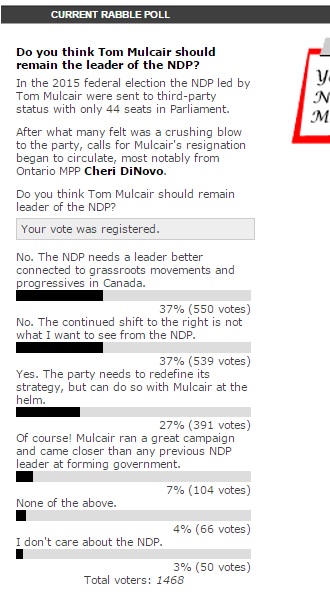
rabble.ca's Tom Mulcair poll and what it says about the disconnect in the left

There is an interesting poll being taken on the left-wing website rabble.ca right now. It asks readers to vote on the following question:

In the 2015 federal election the NDP led by Tom Mulcair were sent to third-party status with only 44 seats in Parliament.
After what many felt was a crushing blow to the party, calls for Mulcair's resignation began to circulate, most notably from Ontario MPP Cheri DiNovo.
Do you think Tom Mulcair should remain leader of the NDP?

As of the time of this posting 74% of those who have voted have said Mulcair should go. While online polls are not at all scientific, it remains an interesting result as the website is directed at and primarily read by Canadians who would be politically inclined to support the NDP.

Again, while also not at all scientific, I have seen this sentiment widely reflected in the comments, threads and thoughts posted online by leftists and progressives broadly. It is rare indeed that one comes across unequivocal continuing support for Mulcair. At best one finds a reluctant support based on the notion that there supposedly does not seem to be an alternative to him at present.

And yet, among those with power and influence in the party the overwhelming narrative is that Mulcair and the NDP lost due to any number of mystical reasons related to things like the orbit of Pluto or the alignment of Saturn's rings, as opposed to having lost due to the utter incompetence of the party's leader, strategists and leadership and due to its totally uninspiring and facile attempt to be more centrist and liberal than the Liberals.

On this blog we have looked repeatedly at how the party and its elite refuses to take responsibility for their campaign and its consequences in posts like The NDP, Nathan Cullen, Paul Dewar and the Canadian social democratic delusionDelusion continues to rule the day in Mulcair NDP, Doubling down on disasterMulcair's NDP ran a great campaign! We know this because they say they did, and others.

Broadly speaking progressive Canadians rejected the NDP in favour of the Liberals and many of those same Canadians, as well as leftists who may have held their nose and voted for the Mulcair NDP or who rejected both the Liberals and the NDP, do not share the delusional notion held by the party elite and many NDP members that the party lost in spite of its campaign as opposed to the actuality that it lost because of it.

This disconnect between the party and those that it needs to support it has never been wider and if it continues, and if Mulcair and his crew remain in place following a fundamentally flawed strategy with a compromised and failed leadership, the NDP slide to irrelevance as a meaningless second Liberal party with ever more tenuous ties to labour will be guaranteed to continue unabated.

As noted above in the rabble poll's preamble, one Ontario MPP, Cheri DiNovo, has had the courage of her convictions to step forward and publicly state the obvious. She has called for him to resign, in the Toronto Star, as leader as his leadership is "tainted" and as the party's strategy was wrong-headed.

But, to date, she is the only high-profile New Democrat, inside-or-outside of a parliament, to do so.

With the leadership review vote near at hand at the spring convention of the party, this does not bode well.

After the disastrous Ontario provincial campaign in 2014 the party delegates at the next provincial convention actually gave Horwath's leadership a higher approval vote than they had at the previous convention prior to the election! This is a testament to the party's deeply insular internal culture dominated by a small group of entrenched people and prone to moronic neo-conspiracy narratives about the "mainstream media" duping everyone, and so on, that are used to avoid any serious self-reflection or self-criticism.

Progressive and left wing Canadians outside the NDP know that Mulcair needs to go and that the party needs to find a reason to continue to exist.

But unless those with power within the party or those with influence over it take action it seems quite likely that Mulcair will easily carry the day at the convention and the suicidal and self-destructive course the party is on will continue.

See also: The NDP, Nathan Cullen, Paul Dewar and the Canadian social democratic delusion

See also: Just forget about a Canadian Corbyn -- How a lackluster left in Canada gets the Mulcair it deserves