Showing posts with label Fidel Castro. Show all posts

Wednesday, May 13, 2020

Fidel Castro and "La Pasionaria", January 1964 -- Daily LIFT #192


Fidel Castro and "La Pasionaria", January 1964 -- Daily LIFT #192

Castro in conversation with Dolores Ibárruri, the heroic Spanish Communist leader also known as "La Pasionaria". During the Spanish Civil War she coined the battle cry “No pasarán! ” as well as famously saying during a speech that "It is better to die on your feet than to live on your knees."

Wednesday, April 22, 2020

Soviet Pin in Honour of the Centenary of Lenin's Birth, 1970 -- Daily LIFT #179


Soviet Pin in Honour of the Centenary of Lenin's Birth, 1970 -- Daily LIFT #179

Today is the 150th anniversary.

Amilcar Cabral:

We are not saying anything new. Today everybody, even the colonialists and imperialists, fully realizes that without the victorious Great October Revolution, without the establishment and consolidation of the world's first socialist state—the Soviet Union—and without the successful continuation of Lenin's cause, the oppressed peoples of Asia, Africa and Latin America would have remained in the darkness of colonial slavery. The political map of the world would have looked quite different, for the anti-imperialist, national-liberation movement would not have assumed the scope and power it has today. Everybody knows that the Leninist analysis of imperialism and imperialist domination is a powerful weapon for the national-liberation movement and all forces fighting imperialism. 

Fidel Castro:

Lenin is a truly exceptional phenomenon in human life ... It is rare when in some process—and perhaps, never in the political process generally —someone's mind, thought, perspicacity were able to make such a huge contribution to the development of that process as the mind, thought and perspicacity of Lenin. 

Tim Buck:

Lenin didn't speak, or write, about the necessity for audacity in the way that Danton did but he showed his capacity for it in a greater variety of engagements and on a greater scale than the famous French revolutionist had opportunity to know of. Lenin demonstrated the decisive role of audacity in revolution more clearly and more dramatically than has any other revolutionary whose activities are recorded. The fact that so little is written about this characteristic of his is striking evidence of the fact that mankind at large, including Communists, is still discovering so much that is new in Lenin's theoretical and ideological work that admiration of his remarkable intellectual audacity attracts the main attention. The personal audacity which was the physically decisive factor in some of the greatest of his historical achievements is usually accepted as though it flowed naturally and automatically from his theoretical conclusions—come to think of it, in his case it did. That's the sort of man that he was. Lenin's personal audacity, the superficial appearance that he didn't even realize the extent of the risk involved, was the more inspiring because it was in fact always the result of conviction, arrived at by careful study, and never of unthinking recklessness. 


Friday, April 10, 2020

Sunday, April 5, 2020

Fidel Castro Addresses Jubilant Crowds During the March to Havana After the Triumph of the Revolution -- Daily LIFT #166


Fidel Castro Addresses Jubilant Crowds During the March to Havana After the Triumph of the Revolution -- Daily LIFT #166


Tuesday, March 24, 2020

Saturday, March 7, 2020

32 Photos of Che Guevara from 1943 - 1967


Over the course of February we shared 29 daily photos of Che Guevara, iconic revolutionary leader and hero. These came from a Soviet archive and many of them are quite unusual.

Here we have compiled all of these into a single post adding three to make 32 photos of Che.

Each photo has a description and some are accompanied by contextual history and quotes.

There is a little bit of everything from family photos, to the Cuban Revolution to trips to the USSR, and on. They span from 1943 to 1967.

Readers can look forward to some more Che photo and art posts from the archive in our Daily LIFT feature over the next couple of months. 


Che at age 15, 1943 


Che trying to climb the Popocatepetl volcano near Mexico City, 1956

"Let me tell you one quality that sums him up, one that I most appreciated, among the many I observed in him ... Che suffered from asthma. Near Mexico City, there's a volcano, Popocatepetl, and every weekend Che would try to climb Popocatepetl. He'd get his equipment in order — the mountain is tall, over 5,000 metres, almost 18,000 feet, with snow year-round — and he'd start the ascent. He'd make a tremendous effort, but he'd never make it to the top. The asthma prevented him. The next week he'd try again to climb Popo, as he called it, but he wouldn't make it. He never made it to the top, he never reached the peak of Popocatepetl. But he kept trying to climb the mountain, and he'd have spent his entire life trying to climb Popocatepetl. He made a heroic effort, although he never managed to reach that summit. So there you see his strength of character. That gives you some idea of his spiritual strength, his constancy." - Fidel Castro interviewed in My Life: A Spoken Autobiography


Che and Antonio Núñez Jiménez after the victory at Santa Clara, 1958

Che and Jimenez after the revolutionary forces triumphed at the Battle of Santa Clara just as 1958 ended. Within a day of this photo being taken the dictator Batista fled Havana and the revolution triumphed, January 1, 1959. Che was wearing a cast as he had been injured previously during fighting at Caibarién.

Jiménez went on to serve the new government in various capacities. He was a noted academic, anthropologist, and writer and was honoured as a revolutionary hero when he died in Havana in 1998.


Che in the captured barracks of the Leoncio Vidal Regiment after the battle of Santa Clara

Che in the captured barracks of the Leoncio Vidal Regiment after the battle of Santa Clara. This was on January 1, 1959, the same day that the dictator Batista fled Havana and the revolution triumphed.

Che was wearing a cast as he had been injured previously during fighting at Caibarién.


Che with his parents in Havana after the triumph of the revolution, 1959


Iconic photo of leaders and heroes of the Cuban Revolution, Che Guevara and Camilo Cienfuegos

Born February 6, 1932, Camilo Cienfuegos was one of the principle revolutionary leaders who, along with Che Guevara and Fidel Castro, helped to bring freedom and socialism to Cuba.


Che with his newborn child

A photo of Che with one of his newborn children. The Soviets dated this as 1960, which would mean it was his daughter Aleida, though other sources say it is his daughter Celia which would make it from 1963.


Planning agricultural reforms shortly after the Cuban Revolution

Che, Antonio Núñez Jiménez and Fidel Castro at a meeting dedicated to land reform and redistribution soon after the victory of Cuban Revolution.


Fidel and Che visit the art show at the Soviet Exhibition in Havana, 1960


Che surrounded by children in Revolution Square, Havana, 1960


"Favourite pastime": Che plays chess, Havana c.1960

Che was an avid, and by all accounts serious, chess player. After the revolution he promoted the idea of chess clubs and tournaments in Cuba and did what he could to popularize the game.


Castro and Che talk off the record at a meeting in Cuba c. 1960


Che with a Portrait of José Martí in Havana after the Revolution


Che doing a shift as a loader when he was Minister of Industries during the agrarian reforms after the Cuban Revolution c. 1960


Che works at a sugar plantation when he was Minister of Industries during the agrarian reforms after the Cuban Revolution c. 1960


Che inspects a mine as Minister of Industries c. 1960

Che personally inspects the working and safety conditions at amine in Cuba when he was Minister of Industries.


Che in conversation with Soviet and Chilean industrial specialists, c. 1961 


Che addresses the Punta del Este Conference, August 1961

Che addresses the Organization of American States (OAS) Conference in Uruguay, 1961. At the conference the United States was already working to have Cuba expelled from the OAS which is was several months later.

Che gave two fiery, famous speeches at the conference. From one of them comes this tremendous quote:
The National General Assembly of the People of Cuba—confident that it is expressing the general opinion of the peoples of Latin America—reaffirms that democracy is not compatible with financial oligarchy, with discrimination against Blacks and outrages by the Ku Klux Klan, or with the persecution that drove scientists like Oppenheimer from their posts, deprived the world for years of the marvelous voice of Paul Robeson, held prisoner in his own country, and sent the Rosenbergs to their deaths against the protests of a shocked world, including the appeals of many governments and of Pope Pius XII. The National General Assembly of the People of Cuba expresses the Cuban conviction that democracy cannot consist solely of elections that are nearly always fictitious and managed by rich landowners and professional politicians, but rather it lies in the right of the citizens to determine their own destiny, as this assembly of the people is now doing. Furthermore, democracy will come to exist in Latin America only when people are really free to make choices, when the poor are not reduced—by hunger, social discrimination, illiteracy, and the legal system—to the most wretched impotence. To sum up, the National General Assembly of the People of Cuba condemns: the exploitation of human by human and the exploitation of the underdeveloped countries by imperialist finance capital.


Che addresses the UN General Assembly, December, 1964

A photo from when Che gave his famous speech to the  19th General Assembly in New York. Che denounced American imperialism and lies and length and quoted from the anti-imperialist Second Declaration of Havana.

It is also remembered for such trenchant moments as when Che said:
The United States intervenes in Latin America invoking the defense of free institutions. The time will come when this Assembly will acquire greater maturity and demand of the U.S. Government guarantees for the life of the blacks and Latin Americans who live in that country, most of them U.S. citizens by origin or adoption.
Those who kill their own children and discriminate daily against them because of the color of their skin; those who let the murderers of blacks remain free, protecting them, and furthermore punishing the black population because they demand their legitimate rights as free men — how can those who do this consider themselves guardians of freedom? We understand that today the Assembly is not in a position to ask for explanations of these acts. It must be clearly established, however, that the government of the United States is not the champion of freedom, but rather the perpetrator of exploitation and oppression against the peoples of the world and against a large part of its own population.

Che's last family photo, end of 1964

Apparently the last known family photo of Che with his second wife Aleida March and their four kids.


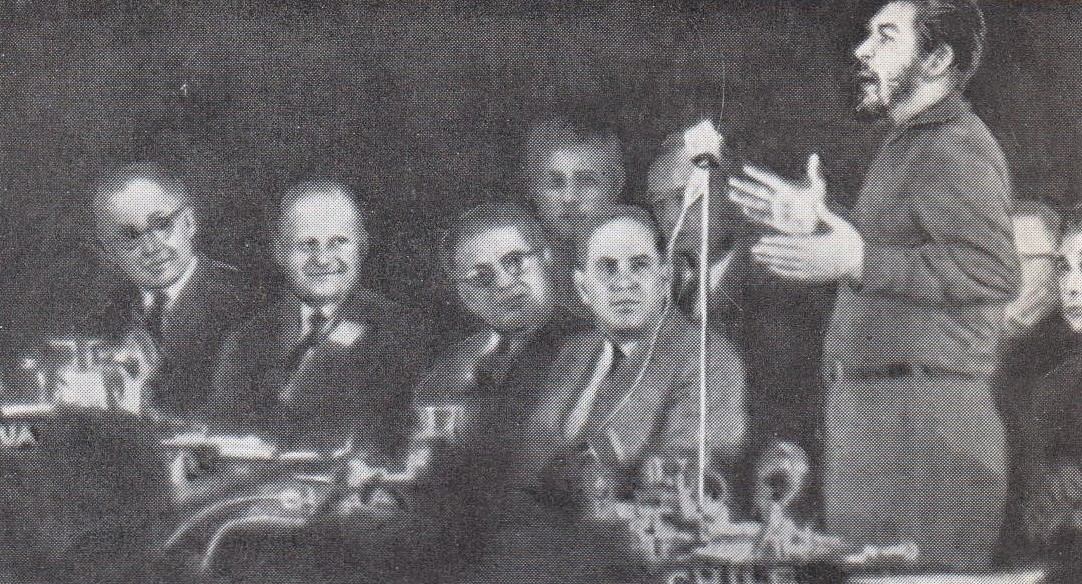
Che addresses a meeting at the House of Unions, Moscow, June 1960

Che was addressing a large audience at an event celebrating the new Soviet - Cuban friendship after the revolution. The House of Unions was run by the Moscow Council of Trade Unions in the Soviet era.


Che visits Lenin's office at the Kremlin, Moscow, 1960


Che visits Lenin's Mausoleum, 1960


Che in Red Square, Moscow, 1960


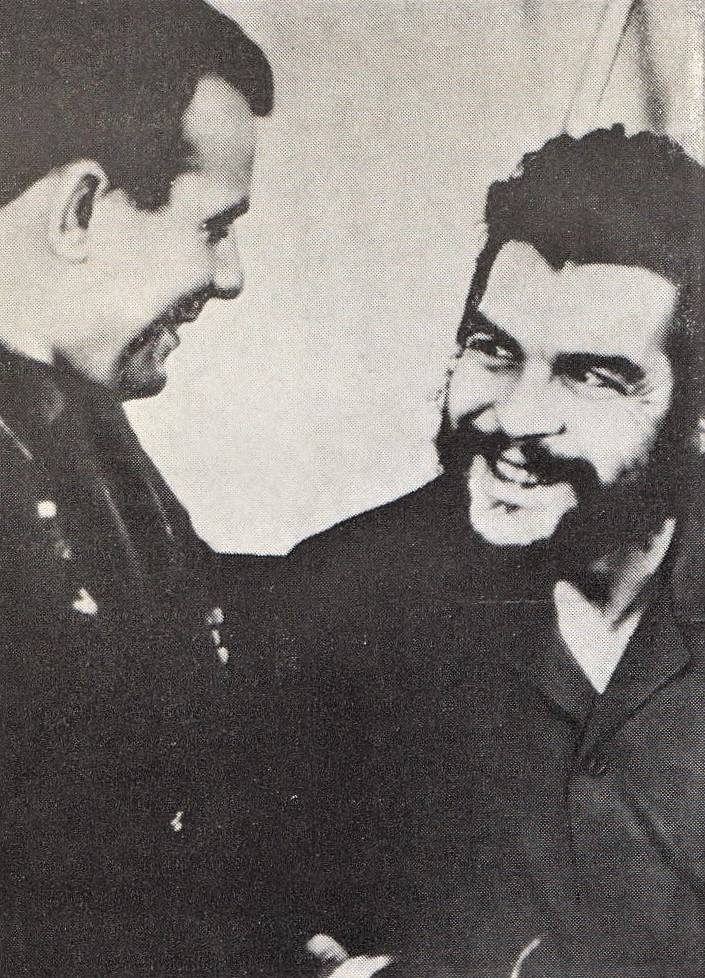
Che and Yuri Gagarin share a laugh

Wonderful photo of Che and Gagarin. It is not dated but is likely from 1964 in Moscow. Gagarin, in addition to be being the first person in space, of course, was also president of the Soviet-Cuban Friendship Society.


Che inspects a Soviet satellite at the Exhibition of Achievements of the National Economy in Moscow, 1960


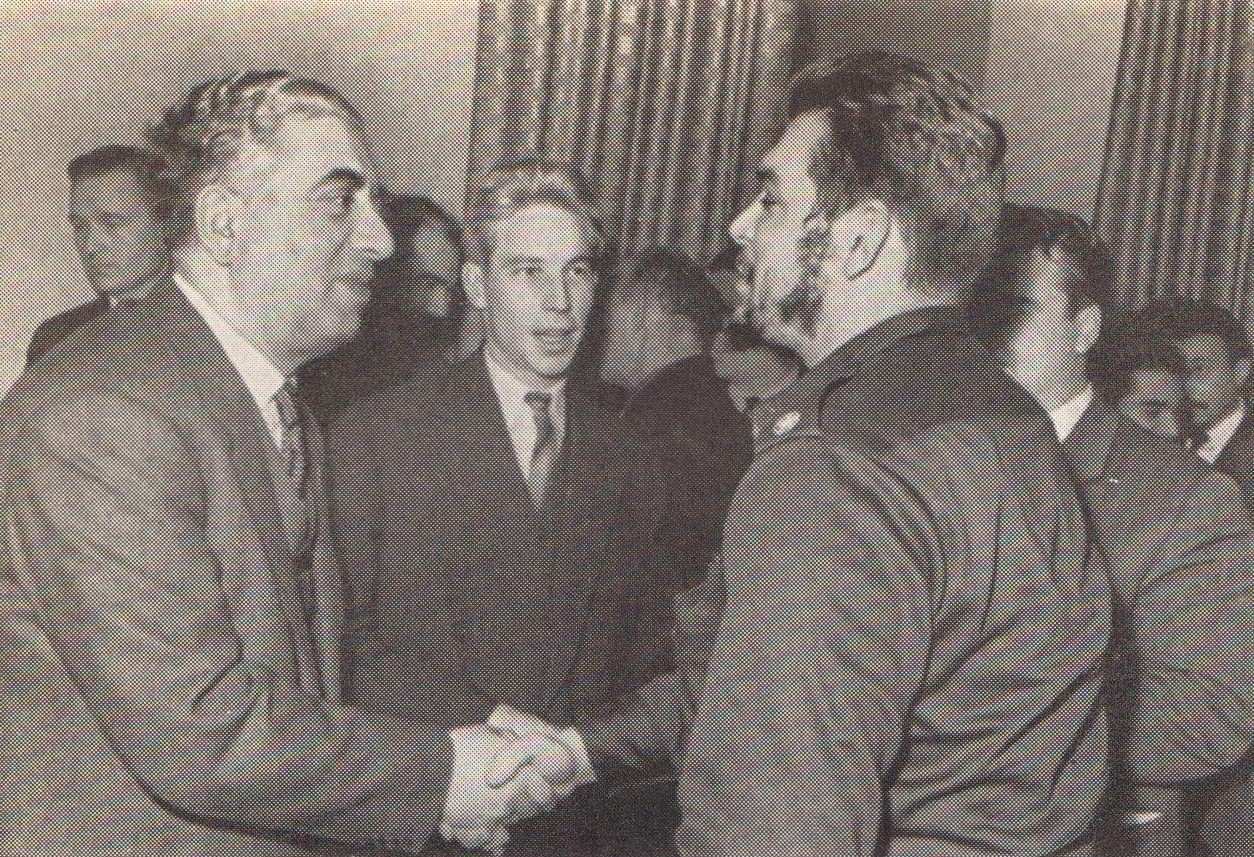
Che meets Aram Khachaturian, Moscow, December 1960

 Khachaturian was a famed Soviet composer from the Armenian SSR


A different look for Che

Che just prior to leaving Cuba for the last time. Undated, but likely early 1965.


Che in disguise in Bolivia, November 1966

The first known photo of Che in Bolivia. Amazingly, that is him on the right in disguise. He had entered the country using a fake passport posing as an Uruguayan businessman after altering his appearance in several ways to, among other things, look older.


Che on lookout duty, Bolivia, 1967


Che in the mountains of Bolivia with the children of local peasants, 1967


Wednesday, February 12, 2020

Castro and Che talk off the record at a meeting in Cuba c. 1960 -- Che Photo #12


Castro and Che talk off the record at a meeting in Cuba c. 1960 -- Che Photo #12

From a collection of Soviet archival photos of Che. The Left Chapter will be doing a daily series of these often unusual Che photos from this archive over the month of February -- some with quotes and history.

Monday, February 10, 2020

Fidel Castro embraces American Paul Mayer when he arrives in Havana as part of the Pastors for Peace Caravan, 1992 - Daily LIFT #124


Fidel Castro embraces American Paul Mayer when he arrives in Havana as part of the Pastors for Peace Caravan, 1992 - Daily LIFT #124

Paul Mayer and other American pastors came to Cuba in defiance of the American economic blockade and despite great obstacles placed in their path. During a speech Castro gave to them after their arrival he said:

"When we talk about what's happening to Cuba, we're already talking about what could happen to any country in the world, especially any Third World country. That's why the battle you are waging today for Cuba is a battle you are waging for the entire world, a battle you are waging for the Third World and for all the nations which have been blockaded for centuries, because they were colonized, exploited and their children enslaved...
...So, what has the world suffered? A 500-year-old blockade. What is neocolonialism? A blockade. What are those neoliberal and ultrareactionary policies? A blockade which forces governments to close their hospitals, to close their schools, to throw the people out onto the streets, to allow people to remain destitute. And in our country, not even during special period when our imports have been reduced to 25 percent of what they were have we closed one single school, one single day-care center, one single hospital. No one has been left destitute. When we don't have any work for them, we pay our workers a salary. At least we give them a salary and though they may have to go home, we don't abandon them...
...What we are doing, the miracle we are performing...could not be performed in a capitalist society. That's why very rich countries that are not blockaded, countries in Latin America that receive aid from the World Bank and other financial institutions, and have a high number of exports, far higher than ours, have closed thousands of schools, hospitals and social institutions. That is what the world is going through. That is why I insist on the idea that to fight for Cuba's cause today is to fight for far more than just Cuba: It is to fight for a just cause for everyone. "

Read more about Cuba's courageous defiance of the blockade at: "The miracle we are performing...could not be performed in a capitalist society" -- Cuban socialism's remarkable accomplishments despite the criminal, imperialist blockade

Sunday, February 9, 2020

Fidel and Che visit the art show at the Soviet Exhibition in Havana, 1960 -- Che Photo #9


Fidel and Che visit the art show at the Soviet Exhibition in Havana, 1960 -- Che Photo #9

From a collection of Soviet archival photos of Che. The Left Chapter will be doing a daily series of these often unusual Che photos from this archive over the month of February -- some with quotes and history.

Saturday, February 8, 2020

Planning agricultural reforms shortly after the Cuban Revolution -- Che Photo #8


Planning agricultural reforms shortly after the Cuban Revolution -- Che Photo #8

Che, Antonio Núñez Jiménez and Fidel Castro at a meeting dedicated to land reform and redistribution soon after the victory of Cuban Revolution.

From a collection of Soviet archival photos of Che. The Left Chapter will be doing a daily series of these often unusual Che photos from this archive over the month of February -- some with quotes and history.

"The miracle we are performing...could not be performed in a capitalist society" -- Cuban socialism's remarkable accomplishments despite the criminal, imperialist blockade


Students from around the world study for free to become doctors at Cuba's Latin American School of Medicine which graduated 466 doctors from 84 countries in 2019, "bringing the total of medical graduates trained at the unique school to over 29,000 – including 182 doctors from the United States".


With research contributed by Nathaniel Laxer 

February 7 marked the anniversary of the imposition of the illegal and criminal, imperialist economic blockade of Cuba by the United States in 1962. Over the course of the last near sixty years of trying to strangle the Cuban economy and destroy its socialist system as a viable alternative in Latin America it has cost the Cuba at least $130 billion US according to the United Nations.

Despite this crime and the terrible impact that it has had on the Cuban people -- especially in the early 90s in the wake of the collapse of the Socialist Bloc and USSR when Cuba lost 85% of its foreign trade and investment and saw its GDP decline by 35%, a time known in Cuba as the "special period" -- the accomplishments of Cuban socialism remain truly impressive.

Once you realize the framework in which Cuba has maintained its independence and freedom, it becomes clear that only socialism can account for what it has achieved.

As Helen Yaffe noted:
Even factoring in its low GDP per capita, the Human Development Index (HDI) lists Cuba in the “high human development” category; it excels not just in health and education, but also in women’s participation and political inclusion. Cuba has eliminated child malnutrition. No children sleep on the streets. In fact, there is no homelessness. Even during the hungry years of economic crisis of the 1990s, Cubans did not starve. Cuba stuck with the planned economy, and it enabled them to ration their scarce resources.
Yes, salaries are extremely low...but Cubans’ salaries do not determine their standard of living. About 85% of Cubans own their own homes and rent cannot exceed 4% of a tenant’s income. The state provides a (very) basic food basket while utility bills, transport and medicine costs are kept low. The opera, cinema, ballet and so on are cheap for all. High-quality education and healthcare are free. They are part of the material wealth of Cuba and should not be dismissed – as if individual consumption of consumer goods were the only measure of economic success.
We could look at many areas, but one area where the magnificent legacy of the revolution shines through most clearly is in healthcare.

After the revolution Cuba was the first country to eliminate polio in 1962 and the first country to eliminate measles in 1996. When the World Health Organization (WHO) kicked off Vaccination Week in the Americas in 2018 they did so in Cuba:
"Vaccination is one of the most powerful tools we have to prevent disease and save lives," said Carissa F. Etienne, Director of PAHO, at the opening ceremony of Vaccination Week in the Americas, which took place at the Victoria de Giron Institute of Basic and Preclinical Sciences in Havana. Ministers and other high-level health authorities from Latin America, the Caribbean, and other regions of the world participated in the launch.
Cuba was chosen to host the regional launch of the campaign because of the great strides the country has made in vaccine development and in eliminating vaccine-preventable diseases, including polio, neonatal tetanus, diphtheria, measles, rubella, congenital rubella syndrome, whooping cough and mumps, said Etienne. "Cuba is a shining example of commitment, investment and passion for health."
Tedros Adhanom Ghebreyesus, Director General of the World Health Organization (WHO), also participated in the regional launch of Vaccination Week in the Week in the Americas, which has served as the base for World Immunization Week since its start in 2012. "Not only does Cuba enjoy universal coverage for vaccines, (it is) also a producer and exporter of these life-saving products," said Dr. Tedros. "World Immunization Week is an opportunity to remind all nations and all people of the incredible value of vaccines."
and:
 During the opening ceremony, the Cuban Deputy Health Minister, Jose Angel Portal Miranda, emphasized that in Cuba "vaccination is available to everyone, free of charge, and can be accessed from primary health care providers. As a result, vaccination coverage in Cuba for all vaccines currently stands at 98%, resulting in high population immunity."
Portal Miranda also highlighted that an average of 4.8 million vaccines against 13 diseases are administered each year in Cuba, with eight of the 11 vaccines that are given being produced in the country itself. He also reminded the audience that the first polio prevention campaign in Cuba took place in 1962 with the vaccination of 2.6 million children and adolescents under the age of 15. 

In fact, Cuba's accomplishments in healthcare are simply stunning. As the BBC noted: "Despite spending a fraction of what the United States spends on healthcare (the World Bank reports Cuba spends $431 per head per year compared with $8,553 in the US) Cuba has a lower infant mortality rate than the US and a similar life expectancy."

An article in the International Journal of Epidemiology noted that Cuba had the lowest AIDS rate in the Americas, the most effective dengue control programme in the Americas, the highest rates of treatment and control of hypertension in the world, had reduced its cardiovascular mortality rate by 45%, provided a free medical education not only for its own students but also for students from Africa and Latin America, and had created an indigenous biotechnology sector which among other things produced the first human polysaccharide vaccine.

Similarly, Cuba has made immense strides in the eradication of tuberculous, which remains a scourge throughout much of the world. In fact, "in 2013, the World Health Organization (WHO) included Cuba on its select list of countries with the potential to eradicate the illness by 2035".

In 2019 Cuba achieved it highest proportion of doctors to people ever, with 9 per 1,000. This is one of, if not the highest, ratios in the world. By contrast, Canada and the United States have 2.6.

Just this year:
Jose Angel Portal Miranda, head of the Ministry of Public Health (Minsap), said that after the revolution, there were barely 3,000 doctors in Cuba. The University of Medical Sciences of Havana, since then, has trained more than 376,000 health professionals including doctors, nurses, and other health professionals.
The head of the Minsap said 35,787 foreign students from 141 countries graduated from Cuban universities, mainly from Africa and Latin America.
This year more than 10,000 medical professionals graduated from Havana, 1,535 of them are from foreign countries. Miranda also stressed that no other small developing countries could achieve such a feat.
Out of the more than 485,000 workers of the National Health System (SNS), some 234,000 are professionals from different branches of medical sciences who work in more than 13,000 health institutions in the country.
Meanwhile, despite the blockade and its stretched resources, Cuba's international medical solidarity is legendary and not just in educating students from other countries to become doctors for free.

From Mozambique, to the Solomon Islands, to tiny Kiribati, to the fight against Ebola, tens of thousands of Cuban doctors have worked around the world in solidarity with other peoples for decades. They even offered aid to the United States in the wake of Katrina which the imperialist cowards declined.

Right wing governments, such as the racist coup regime in Bolivia, have recently sent Cuban doctors home at the behest of the Americans and at great harm to their own people,  but they continue to do their important work in countries like Venezuela.

No matter how hard they try to malign Cuba's internationalist efforts the forces of reaction cannot erase its incredible legacy and history. As of 2019:
...since 1963 Cuban doctors have worked in 164 countries. Non-Cubans graduating as doctors in Cuba (1966-2017) totaled 33, 974. Originating from 135 countries, they include 28,538 graduates (2005-2017) of Cuba’s Latin American School of Medicine, among them 5135 Bolivians, 2071 Ecuadorians, and “more than 1000” Brazilians. In 2017 Cubans were teaching at 7 foreign medical schools. Cuba’s “Operación Milagro” has provided 2.9 million people from 34 countries with no-cost eye operations. Since 1963, Cuban doctors abroad have participated in 1,667,248,707 patient visits; they’ve performed 12,188,554 surgeries. Around 400,000 Cuban health care workers, mostly doctors, have served abroad over the course of 56 years.
Given all this it should come as no surprise that in 2019 the annual Save the Children report that "evaluates 176 countries using international indicators on infant mortality, access to education, nutrition, protection against harmful practices, such as child labour, child marriage, homicides and forced displacement" found that Cuba was safest country in Latin America and the Caribbean to be a child or adolescent.

Still, despite massive international opposition to it, the US blockade continues. In November 187 nations voted for a resolution for it to end at the United Nations, with only 3 voting against and 2 abstaining. Again the United States with its criminality and indifference to international law and opinion shows that it is the world's true rogue nation.

But Cuba stands courageously against this and sets an example for the entire world. Its fight against American imperialism is the world's fight.

As Fidel Castro said in a speech in 1992:
When we talk about what's happening to Cuba, we're already talking about what could happen to any country in the world, especially any Third World country. That's why the battle you are waging today for Cuba is a battle you are waging for the entire world, a battle you are waging for the Third World and for all the nations which have been blockaded for centuries, because they were colonized, exploited and their children enslaved...
...So, what has the world suffered? A 500-year-old blockade. What is neocolonialism? A blockade. What are those neoliberal and ultrareactionary policies? A blockade which forces governments to close their hospitals, to close their schools, to throw the people out onto the streets, to allow people to remain destitute. And in our country, not even during special period when our imports have been reduced to 25 percent of what they were have we closed one single school, one single day-care center, one single hospital. No one has been left destitute. When we don't have any work for them, we pay our workers a salary. At least we give them a salary and though they may have to go home, we don't abandon them...
...What we are doing, the miracle we are performing...could not be performed in a capitalist society. That's why very rich countries that are not blockaded, countries in Latin America that receive aid from the World Bank and other financial institutions, and have a high number of exports, far higher than ours, have closed thousands of schools, hospitals and social institutions. That is what the world is going through. That is why I insist on the idea that to fight for Cuba's cause today is to fight for far more than just Cuba: It is to fight for a just cause for everyone. 


Monday, February 3, 2020

Che trying to climb the Popocatepetl volcano near Mexico City, 1956 - Che Photo #3


Che trying to climb the Popocatepetl volcano near Mexico City, 1956 - Che Photo #3

"Let me tell you one quality that sums him up, one that I most appreciated, among the many I observed in him ... Che suffered from asthma. Near Mexico City, there's a volcano, Popocatepetl, and every weekend Che would try to climb Popocatepetl. He'd get his equipment in order — the mountain is tall, over 5,000 metres, almost 18,000 feet, with snow year-round — and he'd start the ascent. He'd make a tremendous effort, but he'd never make it to the top. The asthma prevented him. The next week he'd try again to climb Popo, as he called it, but he wouldn't make it. He never made it to the top, he never reached the peak of Popocatepetl. But he kept trying to climb the mountain, and he'd have spent his entire life trying to climb Popocatepetl. He made a heroic effort, although he never managed to reach that summit. So there you see his strength of character. That gives you some idea of his spiritual strength, his constancy." - Fidel Castro interviewed in My Life: A Spoken Autobiography

From a collection of Soviet archival photos of Che. The Left Chapter will be doing a daily series of these often unusual Che photos from this archive over the month of February, some with quotes and history.

Tuesday, January 21, 2020

The CPSU: Stages of History December 1980 Part II

Vintage Leftist Leaflet Project

Leaflet: The CPSU: Stages of History December 1980 Part II 

Published in late 1980 in the lead up to the 26th Congress of the Communist Party of the Soviet Union (CPSU) this booklet provided an official overview of the party's history and of each of its congresses to that point.

It begins before the first congress of the Russian Social Democratic Labour Party in 1898 -- the eventual Bolshevik wing of which evolved into the CPSU after the revolution -- with the formation of the League of Struggle for the Emancipation of the Working Class in St. Petersburg, 1895.

Due to length we have divided this post into two parts.


You can read the first part here.

This second part starts at the 21st Congress held in early 1959 and continues until the lead up to the 26th that was held in 1981. It is then followed by an extensive, and very informative, set of indexes that look at the evolution of the party in both size and demographics over the course of its history. There are statistics for overall party membership levels, the national makeup of party members, breakdowns for education levels and employment, the numbers of women in the party and other charts.

The second part, as with the first, has numerous interesting facts, archival photos and illustrations, including of cosmonauts, housing projects, industrial enterprises, etc. There are photos that include historic figures such as Fidel Castro and Ho Chi Minh.

The booklet is told entirely from the line held by the CPSU as the 80s dawned and gives a look at how it saw its own story of revolution, the consolidation of power and, especially in this second part, the struggle to build a socialist society and to reinforce what had been the significant gains of the 1950s through the 70s.

(click on scans to enlarge)