In the mid-1980s the Soviet press agency Novosti released a series of small books looking the USSR's 15 republics. Each book dealt with a republic's history, culture, development, industry, agriculture, etc. They provide a fascinating look at the Soviet Union's accomplishments and plans. The series was known as the "Socialist Republics of the Soviet Union".
Over the coming weeks we will be taking a look at these books and the republics. The books will be slightly edited for length and repetition in some cases and the photographs and illustrations will be dispersed more evenly throughout the text.
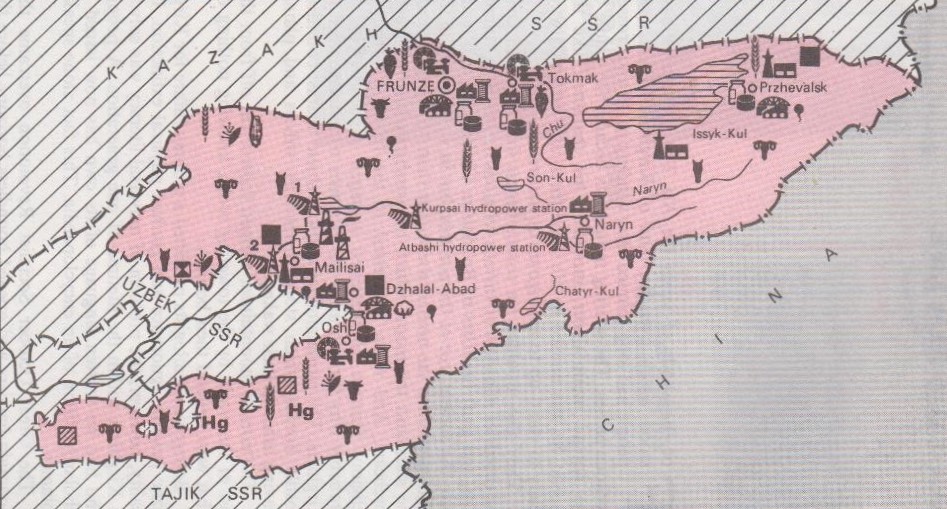
Here we are looking at the Kirghiz SSR, a mountainous region bordering China and the Tajik, Uzbek and Kazakh republics. Written by Kadyr Omurkulov, the booklet touches on the ancient past of the Kirghiz people and the dramatic growth of its economy, educational facilities, healthcare, etc, during the Soviet era.
It is full of remarkable stats such as the rise in hospital beds from 24.1 per 10,000 citizens in 1940 to 119.2 in 1985 or the astounding fact that the republic in 1987 turned out twice as many industrial goods in a single day as it had in all of 1924!
There are pages of incredible photographs showing buildings, squares, people and the breathtaking natural beauty of Kirghizia. Preserving this natural beauty and the environment while launching new enterprises and projects are dealt with as is the challenge of development in such difficult conditions.
There are many stories included as well that one could point to such as the protection and study of ancient monuments like the Buran (or Burana) Tower, the revolutionary history of Frunze, that the republic had a community of Czechs and Slovaks who had immigrated to it for work and to help build socialism in the 20s and 30s (in fact Julius Fucik, a famous Czech Communist resistance fighter murdered by the Gestapo in 1943 visited Kirghizia several times), the way that the region's herdsmen went from what were seen as lowly servants to celebrated workers and legislators after the revolution or the example of Zuurakan Kainazarova who working as a child maid prior to 1917 was forcibly married at age 12 but who went on to throw off the shackles of domestic servitude and to lead a collective farm, save orphans during the war, be twice awarded the title of Hero of Socialist Labour and to serve in the country's Soviet.
(Click on images/scans to enlarge)
In the environs of Arslanbob
Members of an amateur art group at the Kugart State Farm
Embroidering a shirdak -- a woolen carpet
Ulak-Tartysh -- a game in which the team that captures the
carcass of a goat wins.
The shores of Karabalta River
Ancient stone sculptures
Lake Issyk-Kul "the Kirghiz Sea". Holiday makers come from
all parts of the USSR.
At bottom is a research vessel on the lake.
A lecture hall at Kirghiz State University
Catalysis laboratory of the
Institute of Chemistry, Kirghizian Academy of Sciences
Schoolchildren
Heart surgery performed at the
Cardiological Institute of Kirghizia
The museum of regional studies in the city of Osh
Soviet Square in Frunze
New Highways
A performance of King Lear