|
| Lenin Ave. in winter at night |
Published in 1976 this folder of spectacular, panoramic images looked at the city of Magadan and its surrounding region in the far east and north of the USSR.
Magadan had by then grown from a small town to a center of over 100,000 inhabitants. In and around it were many resource based industries such as mining, fishing, lumber, etc.
Here there are photos of city attractions such as theatres, administrative buildings, central thoroughfares, television towers and the like. There are also a number of nature images that convey, as the folder puts it, "the harsh beauty of the north". Among these are shots of island, lake and ocean vistas. In addition we see health and youth resorts.
As someone who owned an independent bookstore I am especially fond of the pictures of the "Knowledge" and "Beam" Bookstores.
The folder was aimed at a domestic audience and was published in Russian. I have translated the notes about the city that accompanied the folder as well as the descriptions of each photo and the blurb that accompanied these.
It is a folder unusually rich in information about its topic and region.
Folder Notes:
"Magadan is still young - only 35 years old. The capital of an area bordered by two oceans. To the people who came to this harsh land and live and work here, the earth has opened up rich storerooms. She gives them her treasures - ash, tin, tungsten, mercury. The entire history of the development of the Magadan region is a history of courage, a history of scientific and labor achievement.
In addition to the non-ferrous metals that are mined in the mines of Kolyma and Chukotka, the region is rich in “soft gold” - furs. Thousands of herds of deer graze on the expanses of the tundra. And the innumerable treasures of the seas and rivers grace many a table. The region exports venison, fish, caviar, crabs, and products of local industry. The world-famous works of Chukchi craftsmen are walrus bone carvers.
In a relatively short time the region has seen the development of open mines, coal mines, gold mines, ore refining plants, a nuclear power plant. The food, meat and dairy industries have grown in the expanses of the Chukchi tundra and the Kolyma taiga.
In addition to Magadan, on the map of the region there are three more young cities that until recently were invisible villages - Anadyr, Susuman and Pevek and two large seaports - Beringovsky and Providence Bay.
The most important scientific center of the region is the Northeastern Complex Research Institute of the Far Eastern Scientific Center of the USSR Academy of Sciences. Besides this, in the region there is an institute of biological problems of the North, research institutes of gold and agriculture, a pedagogical institute, a polytechnic college, a pedagogical school of the peoples of the North - in all about twenty research, design, educational institutions.
In the region there are drama theaters, folk theaters, the State Chukchi ensemble, and three local museums. There are writing and journalistic organizations, and a branch of the Union of Artists of the USSR as well as a book publishing house. Two regional newspapers are published, two district newspapers (in Russian and Chukchi), two television studios are operating - regional and district.With the help of the Orbita system, television programs in Moscow in color and black and white are watched not only in Magadan, but also in the most remote villages of Kolyma and Chukotka.
Having received the Order of Lenin, the region is rightfully proud of its achievements in the fields of culture and the national economy. And its main strength is people, among which there is a large detachment of Heroes of Socialist Labor. These are geologists, biologists, scientists, drivers, builders, miners, pilots. Magadan region is multinational. In addition to the local population that includes the Chukchi you can meet representatives of all the nationalities of our country. This is the brotherhood of nations, a triumph of today, and the key to success in the future."
Images (click to enlarge)
Cinema on Lenin Ave. / Lenin Ave. at Night
Lenin Avenue is one of the longest streets in the world. It begins on a hill near a television tower, cuts the city in half and leaves for the taiga, passing into the famous Kolyma highway. Its length is 1,100 kilometers
Kolyma Highway / Magadan Bus Terminal
Kolyma highway - the "soul of Magadan." It knows no peace and silence, neither at night, nor in the afternoon, nor in the summer, nor in the winter. It is along it that the “general cargo” is delivered to the mining villages of Kolyma.
The "Knowledge" and "Beam" Bookstores
It terms of the number of books per capita Magadan is one of the leaders in the USSR
Main Post Office / Regional House of Political Education
The city is growing by leaps and bounds. Now it has more than 100 thousand inhabitants. That is why, in addition to housing, other new buildings are needed - a new post office, a new Palace of Culture and new libraries.
On Karl Marx Ave.
One of the central streets of the city built in 1939. It lies between the hills, and the townspeople can pick berries and mushrooms without going very far from home.
Talaya Resort
This is a balneological (bath) resort of national significance. Patients from all over the country are treated here.
Regional Orbita Television Tower / M. Gorky Theatre
Magadans can tune into programs from Moscow thanks to Orbita satellite - tower network, the first of its kind in the world.
At the Airport
Passenger and cargo air lines connect Magadan with any city in the Soviet Union
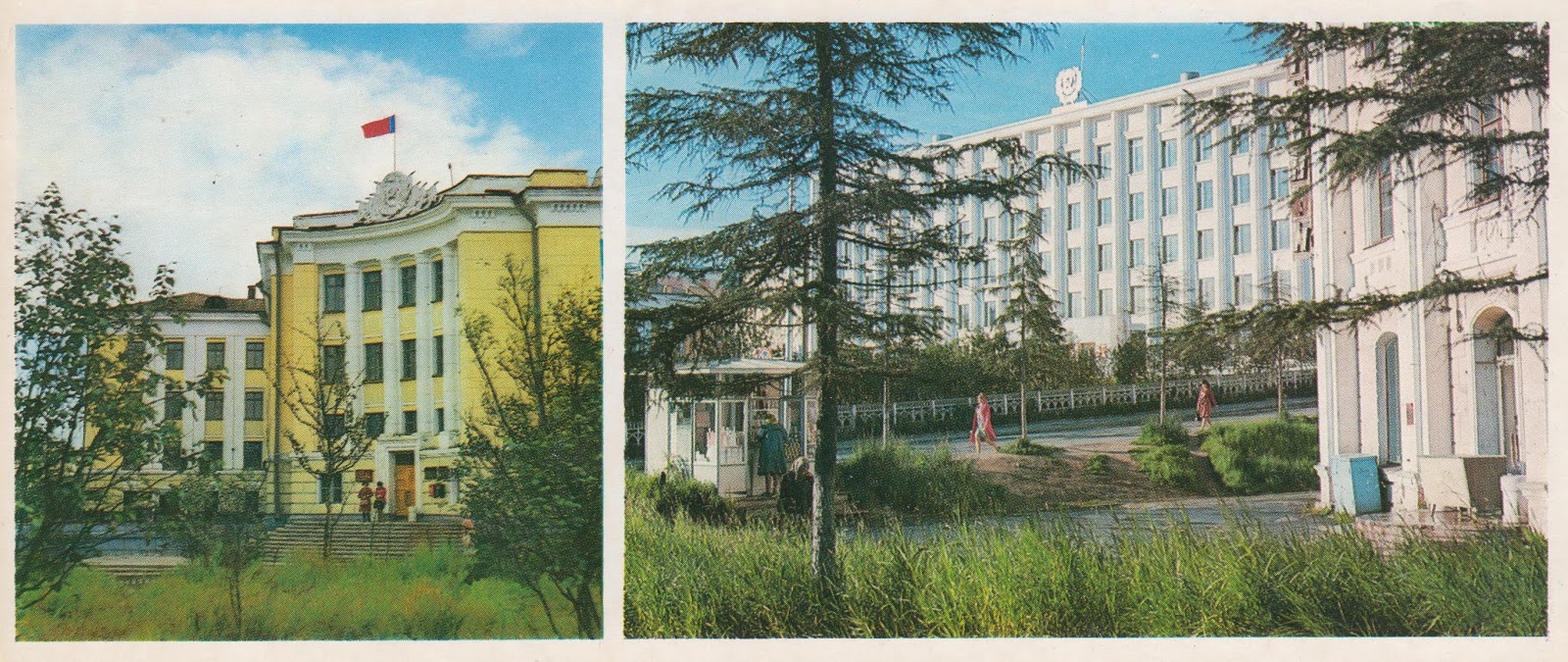
The Building of the CPSU Regional Committee and the Executive Committee /
The Building of the CPSU City Committee and the City Executive Committee
Magadan Region was founded in 1953. It includes the Chukotka National District. The area of the region is 1,200 thousand km. It is the largest in the Soviet Union
Yagodnoye Village / Culture House
The village got its name because of berries, the abundance of which is far beyond those of the central regions of Russia: lingonberries, red and black currants, blueberries, honeysuckle, cloudberries, mountain ash, shiksha and others.
Pioneers Camp
One of the many Pioneer camps of the USSR. Up to 1000 Pioneers of Kolyma and Chukotka have a fun trip here every year.
Ratmanov Island
The hunting of pinnipeds is an ancient occupation of many of the Chukchi people. Due to the observance of hunting rules, the natural balance of pinnipeds is not disturbed.
Inhabitants of Wrangel Island
What is the only island on Earth located in three hemispheres at once? The answer is Wrangel Island. It is completely located in the northern hemisphere, and the 180th merdian passing through it divides the island in half. Part of it is in the western hemisphere, and some in the eastern.
Anadyr Bay
The harsh beauty of the north.
The Harvest of Mining Labour
Nagaev Bay
Fishing for the crabs. shrimp, pollock and the most delicious Pacific herring