Showing posts with label WWII. Show all posts

Saturday, May 9, 2020

Red Army Soldiers Throw Nazi Banners to the Ground, Moscow, June 24, 1945 -- Daily LIFT #188


Red Army Soldiers Throw Nazi Banners to the Ground, Moscow, June 24, 1945 -- Daily LIFT #188

At the end of the first Victory Day parade in Moscow in celebration of the defeat of the Nazis, Red Army soldiers threw the banners of Nazi regiments to the ground outside of Lenin's mausoleum in Red Square. The soldiers all wore gloves so that they would not actually have to touch the banners.

Today is the 75th anniversary of the USSR accepting the surrender of Nazi Germany ending the Second World War in Europe.

The Fall of the Reichstag: An eyewitness Red Army account


Written 20 years after the end of the war, this is a thrilling eyewitness account of the battle for the Reichstag in the final days of the Red Army's victory in Berlin. Its author was Vassily Subbotin who was a 24 year old lieutenant. Subbotin's father was killed in action earlier in the war in fighting in Ukraine.

The account opens with a prose poem, The Road, and then tells of the confused fighting, the terrible deaths with the war just days from ending, negotiations for the surrender of the German troops in the Reichstag, and the story of the raising of the Soviet flag over the building in victory that was preserved in one of the most famous photographs of the war.

We have included some other photos from the account as well.

Today is the 75th anniversary of Victory Day in the USSR.

Republished in 1985 this was an excerpt from a larger book, How Wars End.

Biographical details:

A poet, prose writer and translator, Vassily Subbotin was born in Siberia. His father came from a family of farmers. Both the father and the son went to the front in 1941.

Subbotin's father was killed in action on the 1st Ukrainian Front, while Vassily, then a twenty-four-year-old lieutenant, fought his way with the army into Berlin and took part in the assault of the Reichstag. It was there, during respites in the fighting, that he wrote the first sketches of his future book, How Wars End. It took him, in fact, twenty years to complete the work.

(click on scans to enalrge)


Soviet dice-bombers over Berlin


At the height of the battle


After the storming of the Reichstag


Mikhail Kantaria and Mikhail Yegorov, the men who raised the Banner of Victory


The Nazi emblem thrown down from the Reich Chancellery

Friday, May 8, 2020

Defend Moscow!, Soviet Great Patriotic War Poster, 1941 -- Daily LIFT #187


Defend Moscow!, Soviet Great Patriotic War Poster, 1941 -- Daily LIFT #187

Poster from the dark days of the fall of 1941 as the Red Army rallied in defense of Moscow and the fate of the world hung in the balance. Today is Victory in Europe Day in many countries while tomorrow, May 9, is Victory Day in many countries of the former USSR.

Monday, April 13, 2020

Red Army Soldiers Hoist the Red Banner over Liberated Vienna, 1945 -- Daily LIFT #173


Red Army Soldiers Hoist the Red Banner over Liberated Vienna, 1945 -- Daily LIFT #173

The Red Army liberated Vienna 75 years ago today.

You can read more about this at: Vienna Liberated by the Red Army, April 13, 1945

Vienna Liberated by the Red Army, April 13, 1945

Heroes' Monument of the Red Army, Vienna

75 years since the liberation of Vienna

Statement of the Central Committee of the Party of Labour of Austria

75 years ago, on 13 April 1945, the Red Army of the USSR won the Battle of Vienna. This ended the "Vienna Offensive", which cost the lives of almost 170,000 Soviet soldiers. Up to 20,000 were killed in fighting within the immediate city boundaries of the Austrian capital.

Marshal Fyodor Ivanovich Tolbukhin, Commander-in-Chief of the 3rd Ukrainian Front, led the attack, which had begun on 6 April 1945. After the capture of Budapest, the Red Army, after further heavy fighting in Hungary, had advanced over Burgenland, other units over Bratislava and Brno, in order to largely encircle Vienna. The German-fascist Nazi regime demanded the unconditional defence of the city and again sacrificed some 20,000 lives in a ruthless manner. Attempts by anti-fascist resistance fighters as well as by some war-weary Wehrmacht officers, who wanted to organise a hand-over of Vienna to the Red Army without a fight, failed through treason - only in a local area of western districts of Vienna young communists could succeed in preventing senseless fighting. The Nazi regime's demand that the city should be held by the Wehrmacht and Waffen-SS was a criminal illusion. The superior Red Army was embroiled in bitter positional, street and house fighting in Vienna for a week, but on 13 April 1945 the victorious Soviet soldiers were able to hoist the red flag with hammer and sickle at the Austrian Parliament building in the centre of Vienna.

The liberation of Vienna by the Red Army was a decisive contribution to the further liberation of entire Austria from fascist dictatorship and German foreign rule and to the eventual defeat of Nazi Germany. On April 27, 1945, the Provisional Government in Vienna, consisting of Social Democrats, Communists and Christian-social conservatives, declared Austria's independence from Germany and the re-establishment of the democratic republic - with the support of the Soviet government whereas the Western Allies were not yet ready to recognize this at that time. Meanwhile, fierce fighting continued in other parts of the country, including the province of Lower Austria, which surrounds Vienna. Combat actions on Austrian soil did not end before the unconditional German surrender on 8/9 May 1945.

It is the heroic achievement of the Red Army, the peoples and the political leadership of the USSR to have liberated Vienna and major parts of Austria. This ended the fascist reign of terror, persecution and mass murder by the Nazis, with many Austrians not only being victims but also perpetrators or collaborators. However, many Austrians were also active in the anti-fascist and anti-German resistance, especially communists. They also deserve our gratitude and honourable memory, like the glorious and devoted Red Army and the socialist Soviet Union.

In order to commemorate victory and liberation, the great Heroes' Monument of the Red Army was erected on Vienna's Stalin Square (today's Schwarzenberg Square), on the border between the 1st and 3rd districts, and unveiled on August 19, 1945. It bears the inscription: "Вечная слава Героям Красной Армии павшим в боях с немецко-фашистскими захватчиками за свободу и независимость народов Европы." - "Eternal glory to the heroes of the Red Army, who died in the fight against the German-fascist invaders, for the freedom and independence of the peoples of Europe."

Photo: By Bwag - Own work, CC BY-SA 4.0, https://commons.wikimedia.org/w/index.php?curid=82564766

Wednesday, April 8, 2020

Sunday, March 29, 2020

Mass Rally in Kiev, March 1944 -- Daily LIFT #161


Mass Rally in Kiev, March 1944, in celebration of the liberation of the region from the fascist invaders -- Daily LIFT #161

While Kiev itself was liberated by the Red Army November 6, 1943, fighting in the region around it continued into 1944.

Saturday, February 29, 2020

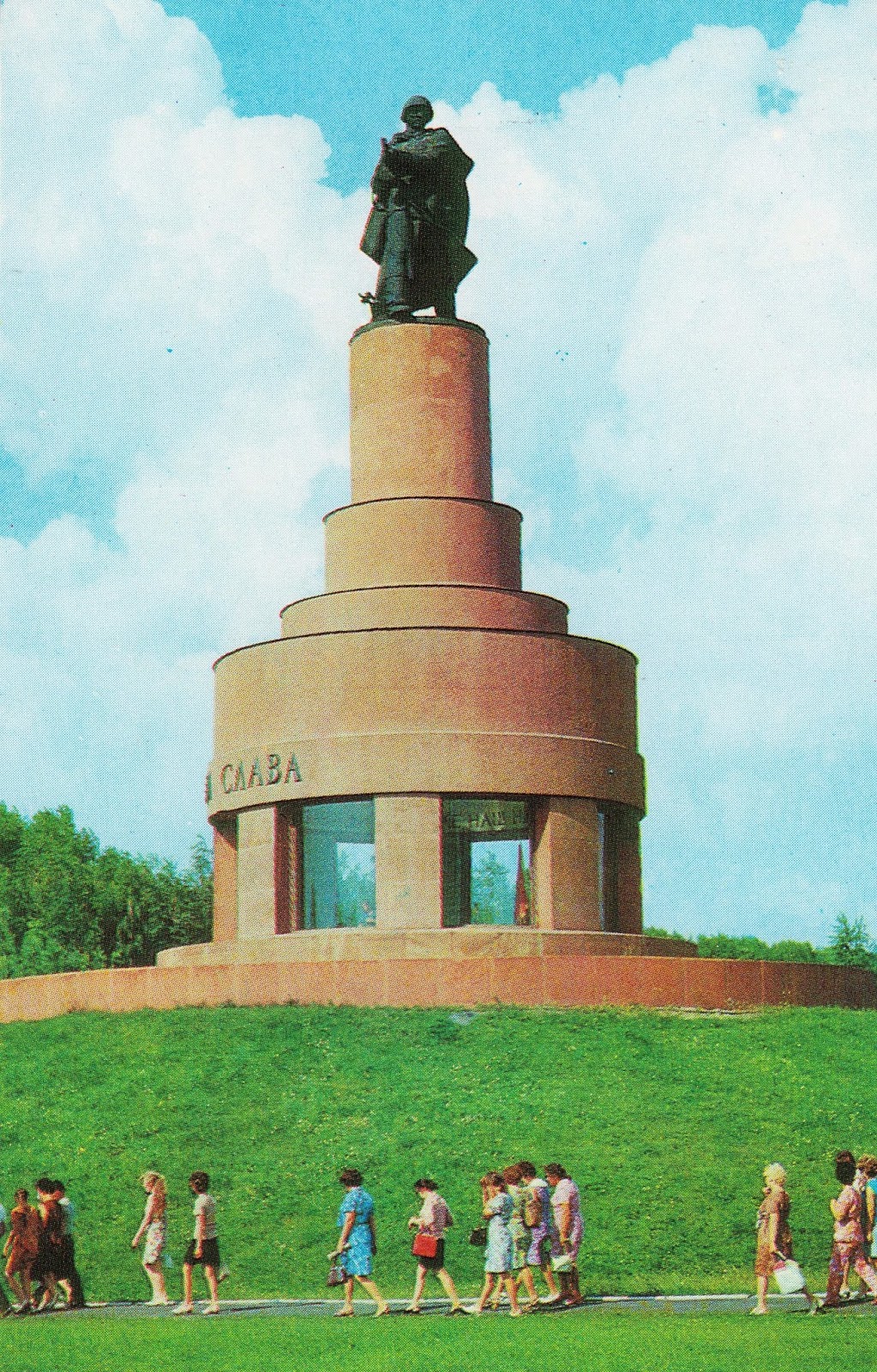
Monument to the Soldiers and Defenders of the City, Hero City of Novorossiysk, USSR, 1979 -- Daily LIFT #138


Monument to the Soldiers and Defenders of the City, Hero City of Novorossiysk, USSR, 1979 -- Daily LIFT #138

Monument first erected in Novorossiysk in 1961 to honour the courage and sacrifices of the people of the city in the fight against the Nazi invaders and occupiers. The city would later be designated as a Hero City of the USSR.

To learn more about the hero cities see the posts Second World War Hero Cities of the USSR w. photos and text Part I and Part II.

Sunday, February 2, 2020

Victory at Stalingrad! Soviet WWII Poster -- Daily LIFT #117


Victory at Stalingrad! Soviet WWII Poster -- Daily LIFT #117

On this day in 1943 the last of the Nazi generals at Stalingrad (General Strecker) surrendered.

The Soviet Red Army, after the largest battle in human history, had delivered a defeat to the Nazis and their allies from which they would never recover.

While many terrible losses and battles lay ahead, the path forward to victories like Kursk and then ultimately Berlin, had begun to be laid.

The sacrifices, courage and resilience of the men and women of the Red Army and the Soviet people at Stalingrad is almost unimaginable and without them it is very likely the Nazis would have won the war.


Monday, January 27, 2020

Saturday, January 4, 2020

Marina Raskova, Hero of the Soviet Union & Bomber Commander, Killed Near Stalingrad, January 4, 1943


Marina Raskova originally wanted to be an actress or singer but became a chemist in the Soviet Union in the 1920s.

Having developed a great love of aviation, Raskova decided to train as a pilot and in 1933 became the first female navigator in the Soviet Air Force. During the 30s she became famous for her skills and for breaking many distance records.

On September 24 - 25, 1938, Raskova, with fellow pilots Valentina Stepanovna Grizodubova and Polina Denisovna Osipenko, "set a Fédération Aéronautique Internationale (FAI) World Record for Distance in a Straight Line Without Landing when they flew a twin-engine Tupolev ANT-37 named Rodina from Tchelcovo, an airport near Moscow, Russia, to the River Amgun, Khabarovsk Krai, in the Union of Soviet Socialist Republics. The distance was 5,908.61 kilometers (3,671.44 miles). The duration of the flight was 26 hours, 29 minutes."

Raskova, with fellow pilots Valentina Stepanovna Grizodubova and Polina Denisovna Osipenko

The plane actually crashed after achieving this feat and Raskova had to wander in the wild for ten days before being rescued. All three pilots were awarded the honour of Hero of the Soviet Union.

When the Nazis and their fascist allies invaded the USSR in 1941, Raskova gave a speech calling for the formation of women's air combat groups and in October Stalin and the military command agreed. In the end three all-women air regiments were created.

These units were all known for their outstanding service and bravery. They included the "Night Witches"  588th Night Bomber Aviation Regiment which we looked at before in the post Nadezhda Popova, Hero of the Soviet Union, Ace Pilot and and Night Bomber b. December 27, 1921.

Raskova commanded the 587th Bomber Aviation Regiment until she was killed in a crash flying a bomber while trying to lead two other planes to safety during a snowstorm near Stalingrad, January 4, 1943.

After her death she received the first Soviet state funeral of the war, her ashes were buried in the Kremlin and she was awarded the Order of the Patriotic War I Class.

Thursday, January 2, 2020

Monument to the Anti-Nazi Partisans of Yaremche, Ivano-Frankivsk Region, Ukraine, USSR - Daily LIFT #89


Monument to the Anti-Nazi Partisans of Yaremche, Ivano-Frankivsk Region, Ukraine, USSR - Daily LIFT #89
Erected in 1970, designed by Semen Tutuchenko

Friday, December 27, 2019

Nadezhda Popova, Hero of the Soviet Union, Ace Pilot and and Night Bomber b. December 27, 1921


Hero of the Soviet Union, Nadezhda Popova, ace pilot and and night bomber was born December 27, 1921. (A few sources date her birth as December 17). 

Popova was the daughter of a railworker and became enamored with flying as a teenager, joining one of the Soviet Union's many flying clubs that were formed in the 1930s. She enrolled in a military flying academy at age 18 and graduated to become an instructor.

When the Nazis and their fascist allies invaded the USSR in 1941, famed Soviet aviator Marina Raskova gave a speech calling for the formation of women's air combat groups and in October Stalin and the military command agreed. In the end three all-women air regiments were created. 

Popova, whose brother was killed in action in the early days of the war, volunteered and was assigned to a night bombing regiment which would become known as the "Night Witches". Often piloting an open cockpit converted crop duster she flew over 800 combat missions, a staggering number. She was shot down several times yet always went back into action. The Night Witches dropped over 23,000 tons of bombs on the fascists. 

Popova was promoted to command of the 2nd Women's Regiment and survived the war to become a lieutenant colonel in the Soviet air force. In addition to being named a Hero of the Soviet Union she was honoured with the Gold Star, the Order of the Red Banner (3 times), the Order of the Patriotic War and the Order of Lenin. 

She died at age 91 in Moscow. 

Wednesday, December 11, 2019

Vasily Zaitsev instructs other Soviet snipers, Stalingrad, 1942 -- Daily LIFT #72


Vasily Zaitsev (far left) instructs other Soviet snipers, Stalingrad, 1942 -- Daily LIFT #72

Hero of the Soviet Union, Vasily Zaitsev is perhaps the most famous of all the heroes of the Red Army in their fight against the genocidal Nazi and fascist invaders.

Zaitsev is credited with having killed 225 Nazi soldiers between November 10 - December 17, 1942 during the Battle of Stalingrad.

He became a member of the Communist Party in 1943 and after the war was a director of a textile factory in Kiev.

Wednesday, November 6, 2019

War Monuments and Sights of Soviet Kiev 1975 -- 16 Vintage Photographs


As we noted in a previous post, November 6 is the anniversary of the liberation of Kiev from the Nazis by the Red Army in 1943. It was liberated on the eve of the 26th anniversary of the Great October Socialist Revolution.


The city had been devastated in the fighting and during the fascist occupation.

This postcard folder of 16 images published in 1975 shows not only how Kiev had been rebuilt and the progress that was being made in the city but also has many monuments to the heroes of the Red Army and the triumph over fascism such as the Monument to the Soviet Tankers and the Monument on the Grave of the Unknown Soldier.

(Click on images to enlarge)


Monument to the Soviet Tankers


State University


Supreme Soviet of the Ukrainian SSR


Monument on the Grave of the Unknown Soldier


Palace of Ukrainian Culture


Exhibition of Excellence in the National Economy


Monument to the January Uprising, 1918
In the January Uprising the workers of Kiev revolted in support of Soviet power.


Victory Square Hotel


Monument to the Liberation of the City from the Fascist Invaders


Airport


Lenin Monument


New Hotel and Housing Estate Buildings


Shevchenko Monument


Monument to the Soviet Prisoners of War Executed by the Nazis


Monument to Nikolai Vatutin, Red Army Liberator of Kiev
Vatutin was murdered in 1944 by Nazi collaborators in an ambush.


Memorial Complex to the Victims of Fascism