Saturday, December 21, 2019

Classic Slow Cooker Beef Stew w. Carrots, Mushrooms and Peppers


Today we are going to take a look at making a classic slow cooker beef stew. With carrots, mushrooms, peppers, onions, tomatoes, red wine and beans, as well as a variety of seasonings, this is a very satisfying winter meal that will cook away all day in your house as you attend to all the many things we need to at this time of year.


Ingredients:

2 lb. stewing beef cubed
1 large can diced tomatoes (do NOT drain) - If you can use one that has "herbs and seasonings" or "Italian seasoned"
1 cup dry red wine - An Italian or Mediterranean red works well. We used Toro Bravo from Spain
1 - 10 ounce can of condensed tomato soup - Campbell's has one with basil and oregano and if you can find it or another brand like it, use that one
1 - 10 ounce can of condensed beef broth
3-4 carrots, sliced
3-4 small white onions or 1 large white onion sliced - alternately you can use 3-4 small shallots sliced
2 sliced, seeded sweet peppers - I like to use a couple of different colours. Here I used one green and half each of a yellow and red pepper
2 cups sliced mushrooms
3-4 minced cloves of garlic
2 teaspoons Italian seasoning
2 teaspoons mustard powder
1 teaspoon (or to taste) cayenne pepper
1 tablespoon Worcestershire sauce
salt and pepper to taste
1 can (14-16 ounces) white kidney (cannellini) beans

Put the beef in bottom of your slow cooker. Blend in the garlic, Italian seasoning, mustard powder, cayenne pepper, salt and pepper.

Add the mushrooms, onion, peppers and carrots and blend together.

Add the tomato, the cans of condensed soup, wine and Worcestershire sauce and stir everything together.


Cover and cook on low for 10 hours. You want the beef to be fork tender so try to cook the full 10 hours or even 11 or 12 hours if possible.

After the cooking time is done, add the can of beans, blend in, cover again and cook on high for 10 minutes.

This deep, rich stew is a meal in itself though it goes nicely with a baguette or garlic bread, rice or mashed potatoes, and some more red wine.


Enjoy.


Friday, December 20, 2019

The Whole World Supports Us. We Will Fight for the South. - National Liberation Front Poster, Vietnam War -- Daily LIFT #78


The Whole World Supports Us. We Will Fight for the South. - National Liberation Front Poster, Vietnam War -- Daily LIFT #78

The South Vietnamese National Liberation Front was formed December 20, 1960.

Thursday, December 19, 2019

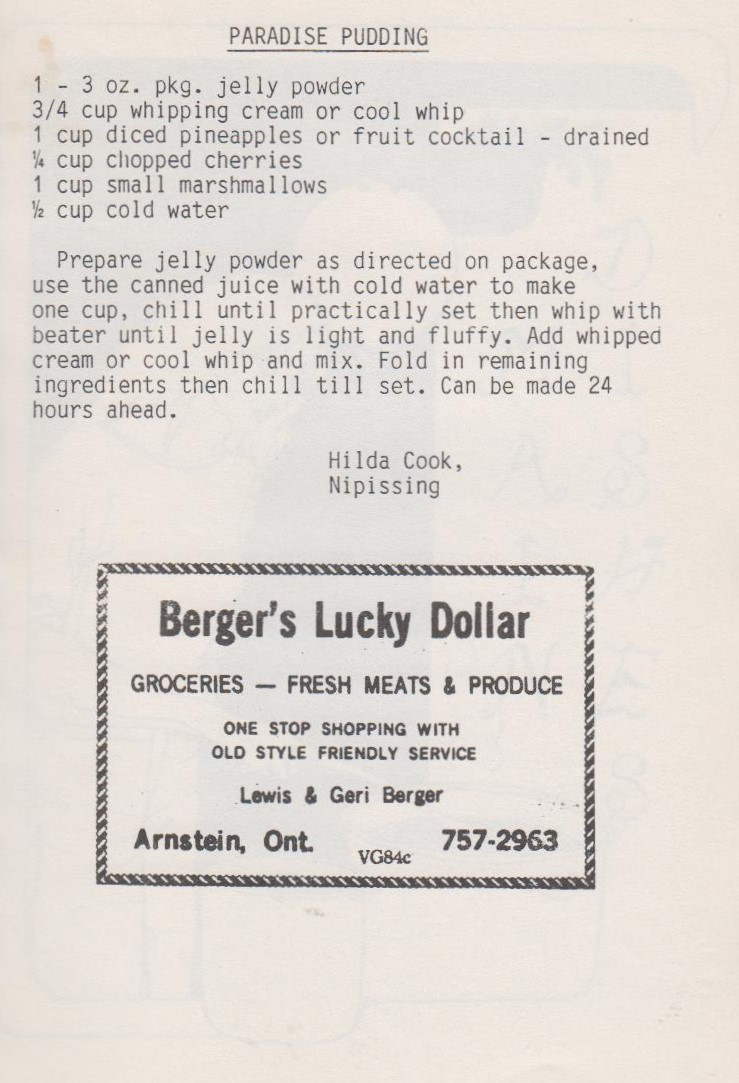
Our Favourite Recipes w. Black Forest Cake, Swedish Meat Balls, Sparerib Sauce & more -- Vintage Cookbook TBT

Vintage Cookbook: Our Favourite Recipes - St. Paul's 25th Anniversary Golden Valley, Ont. 1985

Publication Details: Self-Published, 1985 

Our Favourite Recipes is a classic community cookbook in every possible way.

Published in 1985 it was meant to raise funds for the St. Paul's United Church in Golden Valley, Ontario. Golden Valley is a small community just south of Lake Nipissing and North Bay.

The cookbook has contributions from local residents of Golden Valley itself as well as surrounding towns like Trout Creek and Powassan. It also has mini-advertisements for local businesses that sponsored it.

It is divided into seven recipe sections. These are fairly conventional though there are a very large number of dessert, cookie and pie recipes.

As always with cookbooks with many contributors the quality of the recipes varies considerably and some are rather outlandish. These types of cookbooks are labours of love, though so they are a certain lens into time and place.

Here we have included at least one or two recipes from each section and, as we so often do, a couple of mincemeat recipes.

(Click on scans to enlarge)


Long Live the All-Conquering Banner of Leninism, Maria Nesterova-Berezina, USSR 1957 -- Daily LIFT #77


Long Live the All-Conquering Banner of Leninism, Maria Nesterova-Berezina, USSR 1957 -- Daily LIFT #77

Note that in addition to the 15 emblems of each of the republics of the USSR the artist created a border around the piece of miniature hammer and sickle symbols.

Wednesday, December 18, 2019

Cuba - A Quarter-Century of Working Class Power, Raul Valdes Vivo, 1984

Vintage Leftist Leaflet Project

Leaflet: Cuba - A Quarter-Century of Working Class Power, Raul Valdes Vivo

Written in 1984 this is a look at the Cuban revolutionary movement both before and after the revolution in 1959. Its author, Raul Valdes Vivo, was a Central Committee member of the Communist Party of Cuba at the time. Vivo died in 2013 and was honoured at his funeral by both Fidel and Raul Castro.

Vivo talks of the accomplishments of the revolution, of how it avoided the failings of many prior national democratic revolutions, the internationalism of the revolution as well as the internationalist support it received from the USSR and the Socialist Bloc, and a number of other matters.

"Cuba is...a country of fiery proletarian internationalism. Thousands of doctors, teachers and members of other professions as well as volunteer soldiers help the peoples of the so-called Third World combat illiteracy and disease, build a new life and defend their revolutionary achievements and national independence." To the great credit of the Cuban people this remains just as true now as it did then, despite all the many obstacles they have faced and the criminal American imperialist economic embargo.

(Image is from a Nicaraguan stamp honouring the revolution's anniversary in 1984.)

(click on scans to enlarge)


Tuesday, December 17, 2019

Striking Longshore Pickets Block Produce Trucks Headed to the Port of San Francisco, 1934 -- Daily LIFT #76


Striking Longshore Pickets Block Produce Trucks Headed to the Port of San Francisco, 1934 -- Daily LIFT #76

In May, 1934 longshore workers started a massive strike along the American west coast that hit cities like Seattle, San Diego and San Francisco. They were demanding better working conditions, pay of $1 an hour, a shorter work week and unionization. 

The strikers held out against police and government intimidation as well as a hostile corporate media for many weeks. With monetary losses mounting and the solidarity of the workers holding strong the employers, with police support, decided in early July to open the port of San Francisco by force.

This led to "Bloody Thursday" (July 5, 1934) and the "Battle of Rincon Hill", a pitched fight between workers and police.


11 Vintage Images of Zaporizhia, Ukrainian SSR, 1968


The "Ukraine" Department Store

Zaporizhia (sometimes also spelled Zaporozhye) is a Ukrainian industrial centre that expanded massively from a small provincial town to a large city of hundreds of thousands of residents over the course of the Soviet era. The city was important as a port, for its factories and scientific establishments and for its hydroelectric plant on the Dnieper. 

We have visited Soviet era Zaporizhia before in the post A Cruise Along the Soviet Dnieper, 1985 Part II: Dnepropetrovsk to Odessa where you can find a brief outline of its history, economy, cultural and educational facilities as well as see other photos of it. 

With text in Ukrainian this postcard folder was published in 1968 and was aimed at a domestic tourist audience. It has many interesting shots including of Tatra tram cars on Lenin Ave. (for a more in-depth look at transit in the USSR see: Trams and buses in the USSR -- A look at public transit in the Soviet Union, 1976), the atmospheric photo of Lenin Ave. at night, and the photos of the new housing and high rise blocks. 

The card named The Fountains on Mayakovsky Square almost sounds like the title for a film or novel. 

I have translated all the card descriptions from Ukrainian.  

(Click on images to enlarge)


Lenin Avenue
(Note the Tatra tram cars)


New Apartment Buildings on Lenin Ave.


River Station 


Concert Hall


High Rise Buildings in the Transport Area


300 Year Old Oak Tree in  Khortytsya National Park


Hydroelectric Plant on the Dnieper


The Fountains on Mayakovsky Square


Lenin Statue


Lenin Avenue at Night